


If you’ve been exploring AI tools for ad creation lately, you’ve probably noticed a growing conversation around finding the best Icon alternative. While Icon helped popularize AI-powered video ads, the landscape in 2026 looks very different. New tools are faster, more stable, and built around modern ad workflows rather than just novelty features.
In this guide, we’ll explore why marketers are searching for an Icon alternative, what defines a strong replacement in today’s AI-first era, and which tools are actually worth your time if your goal is simple: creating winning ads consistently.
What Makes a Strong Icon Alternative in 2026
Not every new AI video tool qualifies as a true replacement. A real Icon alternative needs to do more than mimic features — it needs to solve modern creative challenges better.
Here’s what actually matters in 2026.
High-Quality AI Video Generation
In the early days of AI ads, quality was negotiable. Audiences were curious, and novelty carried engagement. But in 2026, the novelty phase is over.
Today’s viewers scroll past thousands of videos daily. They don’t care whether an ad was made by AI — they care whether it feels real.
A strong Icon alternative needs to generate videos that feel native to the platform they live on. TikTok ads should feel like TikToks. Reels should feel organic. UGC should feel human, not synthetic.
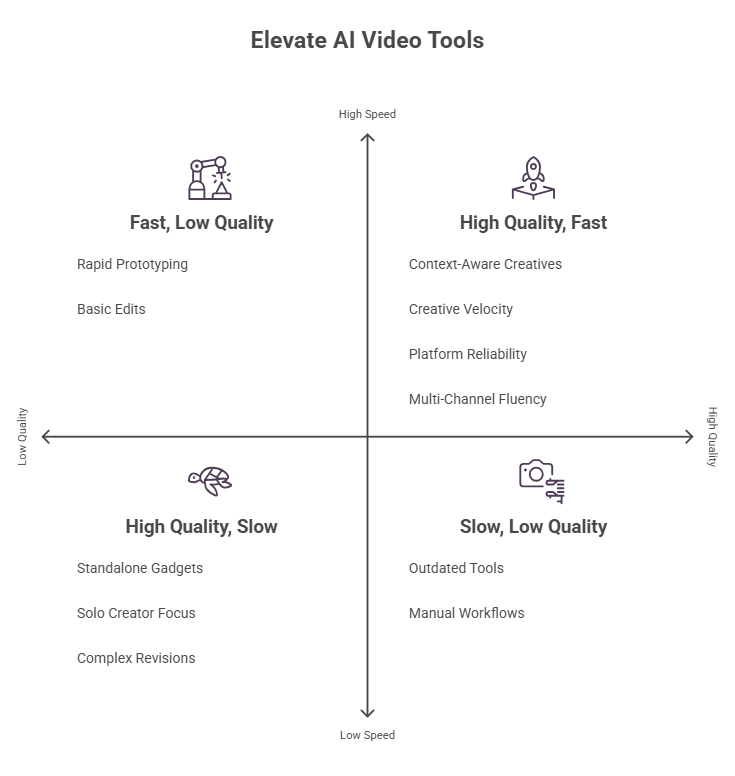
This is where newer tools are pulling ahead. They don’t just generate videos — they generate context-aware creatives. Lighting, pacing, framing, even emotional tone are starting to align more closely with real user-generated content.
And that realism directly translates into performance.
Fast Editing and Iteration Speed
If quality wins attention, iteration wins scale.
One of the biggest shifts in modern advertising is the rise of creative velocity. The winning brands aren’t always the most creative — they’re the most adaptive. They test faster, learn faster, and refresh creatives before fatigue sets in.
A true Best Icon alternative should reduce friction between idea and execution. That means faster rendering, easier revisions, and modular editing systems that let you tweak hooks, CTAs, or visuals without rebuilding everything from scratch.
In other words, the tool should feel less like a video editor and more like a creative sandbox.
Platform Reliability and Performance
It’s not the flashiest feature, but it’s the one that keeps teams sane.
A dependable Icon alternative should feel boring in the best way possible. No random crashes. No unpredictable export issues. No sudden slowdowns during peak campaign hours.
When teams evaluate AI tools today, they’re not just asking, “What can it do?” They’re asking, “Can we trust it at scale?”
Because once you’re running multiple campaigns across multiple channels, reliability stops being a technical detail — it becomes a competitive advantage.
Built for Modern Marketing Workflows
The biggest difference between early AI tools and newer platforms is workflow awareness.
Older tools were built like standalone gadgets. Newer ones are built like ecosystems.
A modern Icon alternative understands that ads don’t exist in isolation. They’re part of a pipeline that includes ideation, collaboration, testing, iteration, and scaling. The best tools plug into that flow naturally instead of forcing marketers to adapt around them.
Collaboration and Team Use Cases
AI tools used to be a haven for solo creators. That’s not really the case anymore. These days, even small brands work more like tiny agencies. You’ll see media buyers, designers, founders, and freelancers all working together—even if they’re scattered across the globe. In this kind of setup, shared projects, version control, and cloud editing aren’t just nice-to-haves. They’re the basics.
A real Icon alternative needs to make teamwork easy, not confusing. You want clear handoffs, simple revision tracking, and obvious ownership of creative files. When you get that kind of clarity, collaboration just works. And suddenly, you’re not just moving faster—you’re improving everything, over and over again.
Multi-Channel Ad Support (TikTok, Meta, YouTube)
Not all platforms speak the same creative language.
TikTok rewards raw authenticity. Meta still leans into structured storytelling. YouTube Shorts often favors hybrid styles. A one-size-fits-all creative rarely performs everywhere.
That’s why the best Icon alternative in 2026 needs to be channel-aware. It should help creators adapt formats, pacing, and framing based on where the ad will run — without forcing manual rebuilds for every platform.
Multi-channel fluency isn’t just a feature anymore. It’s a survival trait.
5 Best Icon Alternatives for Creating Winning Ads
Now let’s get practical. If you’re actively searching for a Best Icon alternative, here are the tools that consistently show up in real-world creator stacks — not just on feature lists, but in actual campaigns.
1. UGCMaker – Best for Fast AI UGC-Style Video Ads
If your goal is speed and performance, UGCMaker is one of the most compelling Icon alternative options right now.
Unlike tools that focus on cinematic polish, UGCMaker leans heavily into what actually converts in modern ad ecosystems: UGC-style videos that feel native, fast, and believable.
Instead of overproduced visuals, it prioritizes authenticity — the kind that blends seamlessly into social feeds.
Key Features
One of the biggest strengths of UGCMaker is how tightly it compresses the creative process.
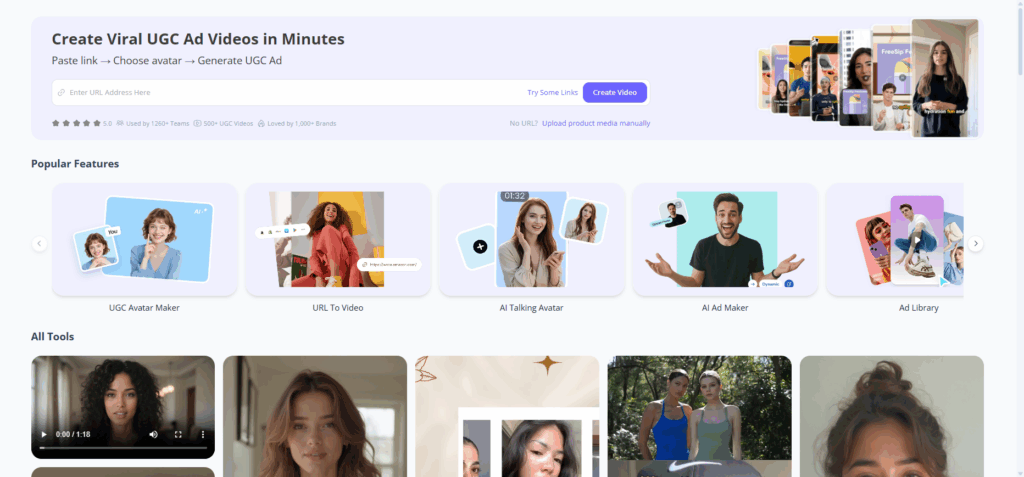
It allows marketers to generate AI-driven UGC-style ad videos that mimic real creator content. This includes natural pacing, conversational delivery, and formats optimized for short-form platforms.
Its script-to-video automation dramatically lowers the barrier between idea and output. Instead of juggling tools, users can move from concept to export in a single workflow.
Another standout element is the inclusion of built-in hooks and ad templates. These aren’t just visual presets — they’re structurally informed by high-performing ad patterns, which helps newer marketers avoid the “blank canvas paralysis.”
Pros and Cons
Like any tool, UGCMaker isn’t trying to be everything.
On the plus side, it excels at speed and practicality. It’s built for marketers who prioritize iteration and testing volume. The learning curve is gentle, and the output is immediately usable in performance campaigns.
On the downside, creators looking for cinematic storytelling or deep manual editing may find it less flexible than advanced creative suites. But that trade-off is often intentional — it sacrifices polish for momentum.
And in performance marketing, momentum often wins.
Best For
UGCMaker shines brightest in environments where speed equals leverage.
Performance marketers will appreciate how quickly they can spin up variations for testing. Short-form specialists, especially those focused on TikTok-style ads, will find its UGC orientation particularly aligned with platform dynamics.
For teams exploring an Icon alternative specifically to increase creative throughput, UGCMaker represents a very practical starting point.
2. Creatify – Best for AI Avatar Video Ads
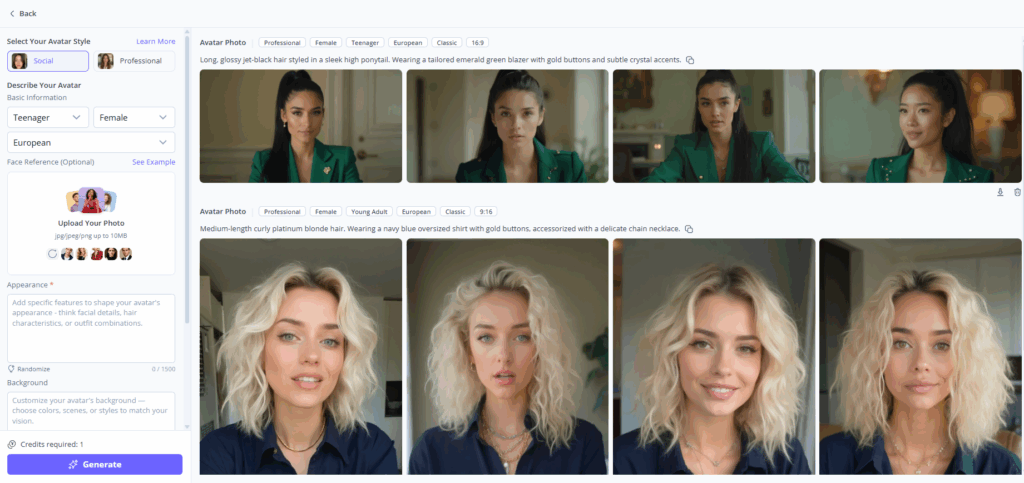
Creatify stands out from Icon by taking a different approach. Instead of chasing that raw, user-generated look, it puts AI avatars front and center in video creation. That’s a big win for brands that want the same on-screen presenter every time, without the hassle of hiring new talent for each project. Its text-to-video tools and support for multiple languages make it a great fit for global campaigns and product explainers. If you want your ads to have a clear message and a friendly face—without giving up control—Creatify hits that sweet spot between automation and personal touch.
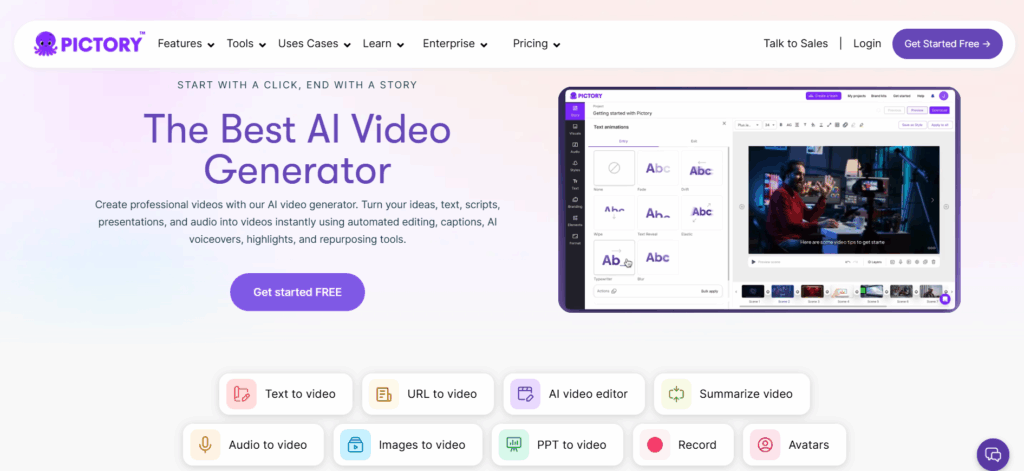
3. Pictory – Best for Repurposing Content into Ads
If you already produce long-form content — webinars, podcasts, YouTube videos — Pictory positions itself as a practical Icon alternative focused on repurposing rather than raw creation.
Instead of starting from scratch, Pictory transforms existing material into short-form, ad-ready assets. For brands sitting on mountains of unused content, this can feel like unlocking hidden inventory.
Its AI can extract key highlights, auto-generate captions, and reshape long narratives into bite-sized formats optimized for social feeds. In a world where attention spans shrink by the month, that compression is valuable.
However, Pictory shines most when you already have strong source material. If your strategy relies on high-volume ad testing from scratch, tools like UGCMaker may feel more aligned. But as a complementary Icon alternative, especially for content-heavy brands, Pictory offers a smart bridge between content marketing and paid acquisition.
4. Synthesia – Best for Professional AI Video Production
UGCMaker goes for a scrappy, high-energy vibe, while Synthesia feels more polished and corporate. As an Icon alternative, Synthesia stands out for its slick AI avatars, studio-quality delivery, and clear focus on big business. Lots of companies use it for B2B marketing, training videos, and product demos.
The real strength? Consistency. If your brand needs structure and authority, Synthesia is your friend. You feed it a script, and it turns out sharp, professional videos every time—no surprises, none of the messy unpredictability you get with UGC.
But let’s be real: this style doesn’t always fit everywhere. On platforms like TikTok or Reels, Synthesia’s high-gloss tone can feel out of place—almost like dropping a billboard into a group chat.
Still, for agencies and enterprise teams who want a scalable Icon alternative and need reliable results, Synthesia is tough to beat.
5. Runway – Best for Advanced AI Video Editing
Runway occupies a different category altogether. Rather than being purely an AI ad generator, it functions more like an AI-powered creative lab.
If you want background removal, generative video effects, motion tracking, or cinematic AI enhancements, Runway offers capabilities that go far beyond template-based ad creation.
As an Icon alternative, it appeals to creative teams who want maximum flexibility. You’re not just generating ads — you’re crafting visuals with AI assistance.
But with power comes complexity. Runway requires more creative skill and experimentation. It’s less plug-and-play and more sandbox studio.
For high-production campaigns or brands pushing visual storytelling boundaries, Runway provides creative depth that simpler Icon alternative tools don’t attempt to match.
How to Choose the Right Icon Alternative for Your Needs
With so many AI video tools entering the market, choosing the Best Icon alternative isn’t about chasing features — it’s about aligning with your growth model.
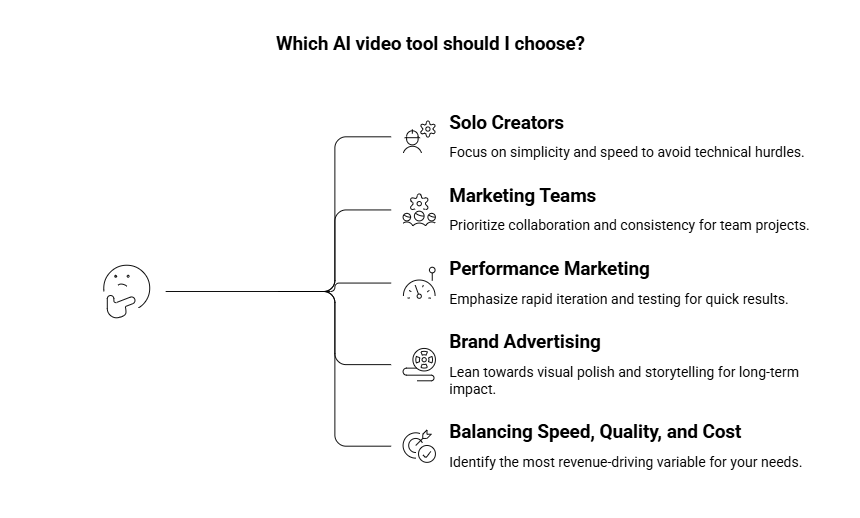
Here’s how to think about it strategically.
Solo Creators vs. Marketing Teams
If you’re working solo or building something on your own, keeping things simple really counts. You need tools that move fast, feel natural, and don’t slow you down. That’s where something like UGCMaker comes in—it cuts out the extra steps so you can just focus on what you want to say, while it takes care of the technical stuff.
But teams need different things. They care more about everyone being able to jump in, track changes, and get the same results every time. For them, it’s less about the latest feature and more about making sure everything runs smoothly together.
So picking an Icon alternative isn’t just about how creative you can get. It’s about whether the tool actually fits the way you work.
Performance Marketing vs. Brand Advertising
Performance marketing prioritizes testing volume. You want rapid hook variations, different angles, fast iteration cycles.
Brand advertising, however, emphasizes consistency and narrative depth. Production value may outweigh raw speed.
If your strategy revolves around aggressive A/B testing on Meta or TikTok, prioritize tools that optimize iteration velocity. If you’re building long-term brand perception, lean toward platforms that enable visual polish and structured storytelling.
The Best Icon alternative for a DTC testing machine might not be the same as for a B2B SaaS brand.
Balancing Speed, Quality, and Cost
Every tool lives somewhere on the triangle of speed, quality, and cost.
Some Icon alternative platforms optimize speed at the expense of cinematic detail. Others provide stunning visuals but require more time and budget.
The smartest approach isn’t chasing perfection — it’s identifying which variable moves revenue fastest in your specific model.
In 2026, speed often beats perfection. But context still rules.
Tips for Creating Winning Ads with an Icon Alternative
Having the Best Icon alternative won’t guarantee performance. But using it strategically can dramatically improve outcomes.
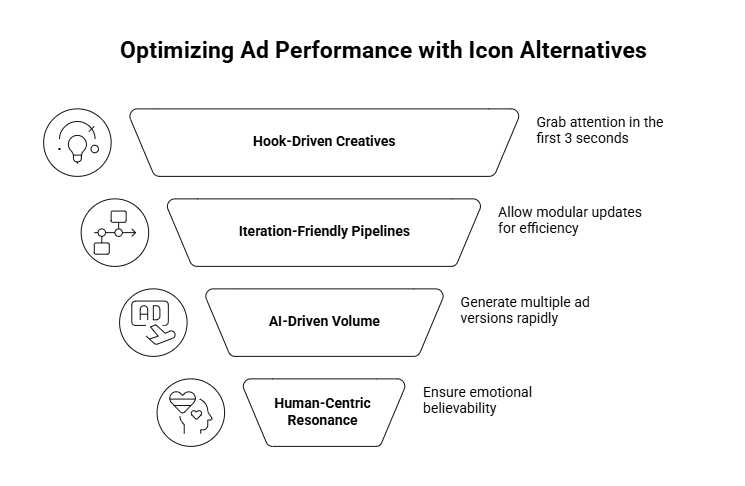
Nail the First 3 Seconds (Hook-Driven Creatives)
In short-form ads, those first three seconds matter most. AI tools let you whip up all kinds of hooks, so try out bold statements, play with emotions, shake things up—see what grabs people. Forget about perfecting the whole script right away. First, get their attention. Only then can you convince them.
Build Iteration-Friendly Creative Pipelines
Instead of producing one “perfect” ad, build systems that allow modular updates.
Swap hooks. Change CTAs. Adjust visuals without recreating the entire video.
Tools like UGCMaker are particularly effective here because their structure encourages repeatable creative frameworks. When iteration is frictionless, scale becomes predictable.
Combine AI Scale with Human Insight
AI can generate volume. But humans still interpret emotion.
Using AI for Volume
Leverage AI to create multiple versions rapidly. Use it to test messaging angles you might otherwise hesitate to explore.
Volume generates data. Data generates clarity.
Using Humans for Emotional Resonance
But don’t outsource empathy to algorithms.
Review outputs with a human lens. Ask: Does this feel believable? Would I stop scrolling for this?
The strongest campaigns in 2026 blend AI efficiency with human storytelling instinct.
Should You Switch from Icon in 2026?
Switching tools isn’t always necessary. But evaluating options is smart.
Signs It’s Time to Try an Alternative
You might consider exploring a new Icon alternative if:
- Creative output feels repetitive
- Iteration speed is slowing down
- Stability concerns affect campaign timelines
- Your workflow has outgrown the platform
Growth often demands evolution.
When Staying with Icon Still Makes Sense
If Icon works for you, gets the job done, and doesn’t break the bank, sticking with it makes sense. Not every change needs to shake things up. Still, it pays to know what else is out there. When you understand your options, you get more leverage and flexibility when it’s time to make decisions.
Building a More Resilient Creative Stack
The smartest marketers in 2026 don’t rely on a single platform. They build layered creative stacks.
One tool for fast UGC-style production.Another for polished brand videos.A third for advanced editing.
Exploring the Best Icon alternative isn’t about replacing everything — it’s about future-proofing your creative engine.
Conclusion
The search for the Best Icon alternative in 2026 isn’t driven by hype. It’s driven by evolution.AI video advertising has matured. Marketers now expect more — more stability, more flexibility, more speed. Whether you’re testing short-form hooks at scale with UGCMaker, building avatar-led explainers, or experimenting with cinematic AI editing, the right Icon alternative can dramatically impact your creative momentum.
In the end, tools don’t win campaigns — systems do. But the tools you choose shape those systems. If your goal is simple — create winning ads consistently and sustainably — then exploring a strong Icon alternative might not just be an upgrade. It might be the strategic shift that keeps you competitive in 2026 and beyond.