


You have about three seconds before someone decides whether to keep watching your ad or swipe past it forever. That's not an exaggeration, it's just how short-form video works. The hook is the only part of your UGC video that has to do real work before the viewer has even decided to trust you.
Most "viral hooks" lists online are swipe files: a pile of fill-in-the-blank lines with no context on when to use them, why they work, or how they perform once you're running them as paid ads instead of organic posts. That's a problem, because a hook that stops the scroll on someone's personal feed isn't automatically the same hook that stops the scroll on a sponsored post, viewers are more skeptical, faster to judge, and less forgiving of anything that smells like a sales pitch.
This guide is built specifically for that gap. Below you'll find 25 hooks organized into four categories based on how they grab attention, verbal, text-overlay, visual, and problem-agitation, along with a short note on the psychology behind each one and an ecommerce-style example so you can see how it actually plays out in a product ad, not just a lifestyle vlog. At the end, we'll cover how to turn any of these templates into a finished UGC video without writing a script from scratch or booking a creator.
What Makes a Hook "Viral" in UGC Ads (vs. Organic Content)
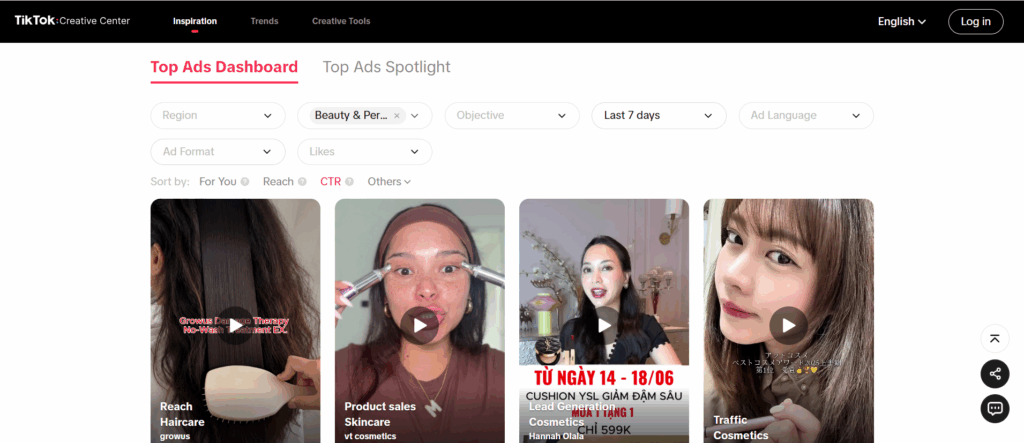
Organic creators and paid UGC ads are chasing the same three seconds, but they're not playing the same game.
On an organic post, the viewer already follows the creator or landed there through a trend, sound, or hashtag they're interested in. There's a baseline of trust or curiosity built in before the video even starts.
On a UGC ad, none of that exists. The viewer doesn't know the person on screen, didn't ask to see a product, and is primed to detect, and skip, anything that feels like an ad. That changes what a hook needs to do:
- It has to feel native first. The best-performing UGC hooks borrow the visual and verbal language of organic content, handheld camera, natural lighting, casual phrasing, because that's what earns the first half-second of trust before the brand message lands.
- It has to create a small, specific tension. Vague curiosity ("you won't believe this") works less reliably in ad placements because skeptical viewers assume it's clickbait. Specific tension, a number, a named mistake, a before/after, survives that skepticism better.
- It has to connect to the product within the first 5–8 seconds. Organic hooks can meander before revealing the point. Ad hooks that delay the product reveal too long tend to lose viewers who correctly sense they're watching an ad and want to know what's being sold.
Keep those three filters in mind as you read through the hooks below, they're why each example is written around a product moment rather than a generic life update.
4 Types of Viral Hooks
Rather than one long, randomly ordered list, it helps to know what kind of attention each hook is built to grab. We've grouped all 25 into four categories:
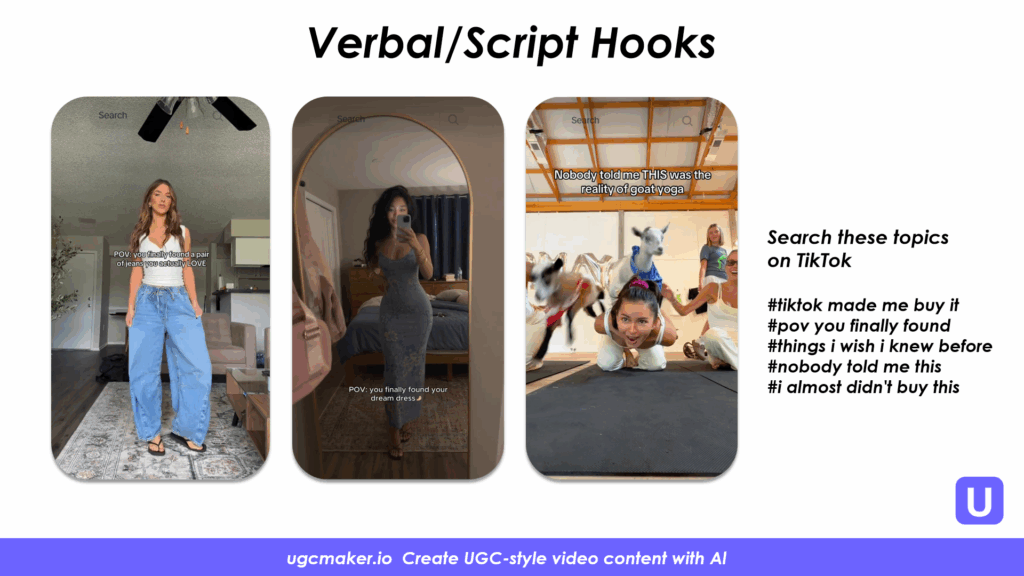
- Verbal/Script Hooks, the first line spoken on camera
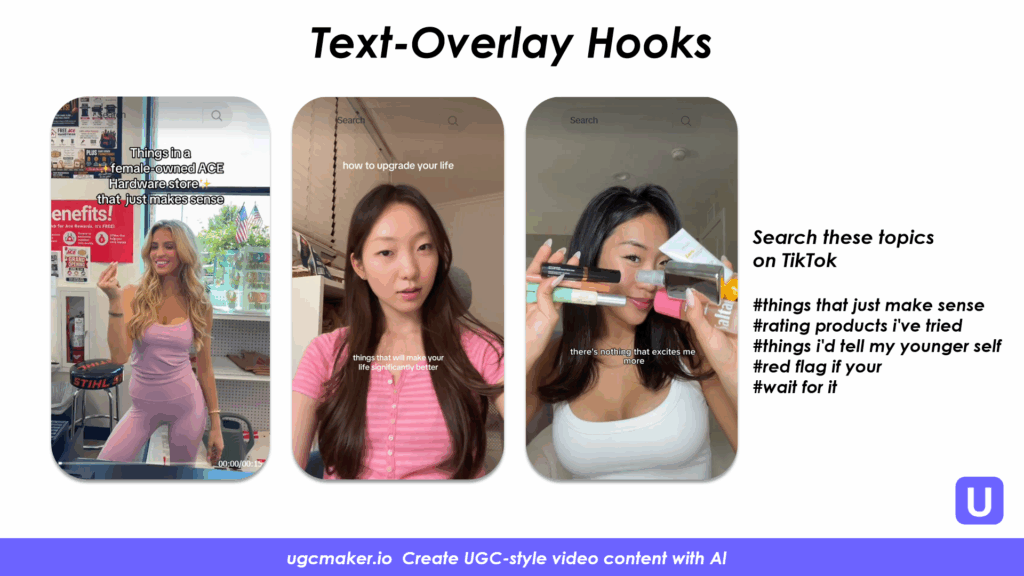
- Text-Overlay Hooks, the on-screen caption that appears before or under the spoken hook
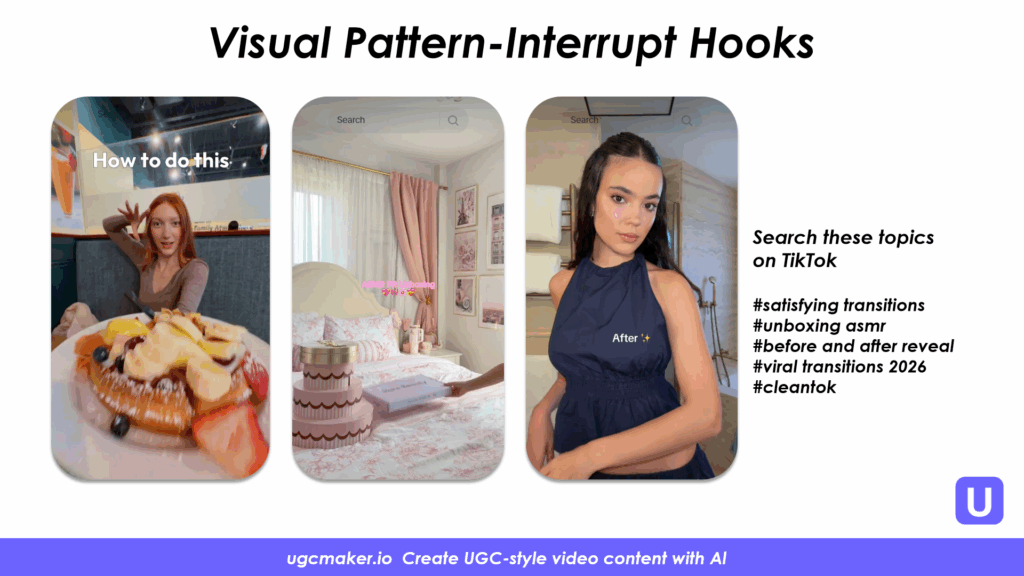
- Visual Pattern-Interrupt Hooks, the action or framing choice that breaks the scroll, independent of what's said
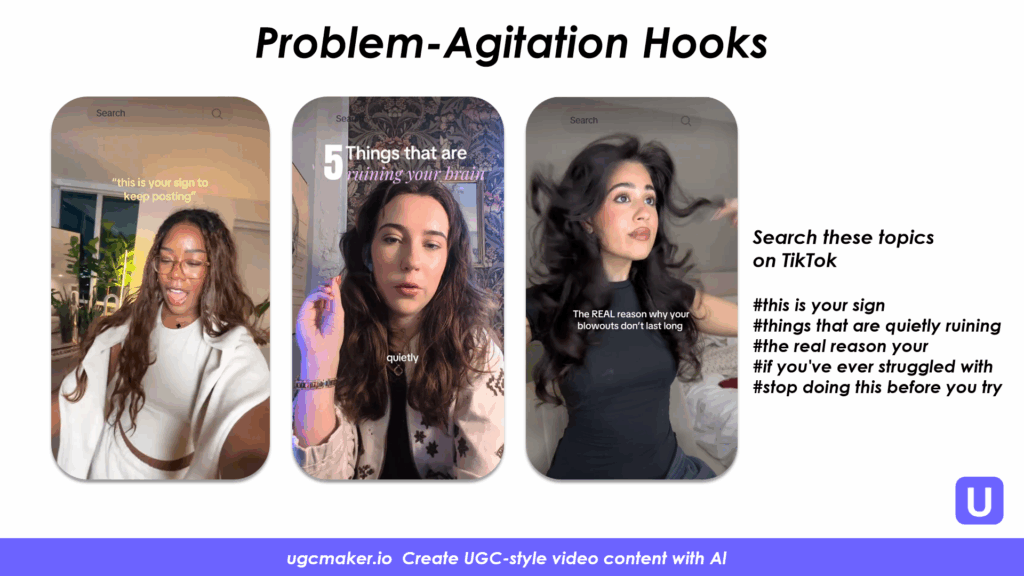
- Problem-Agitation Hooks, hooks built around naming a pain point the viewer already feels
Most high-performing UGC videos actually stack two of these at once—for example, a visual pattern-interrupt paired with a verbal hook, or a text overlay reinforcing what's being said. Once you've got the individual templates down, mixing categories is where the real lift in watch time tends to come from.
The biggest advantage here? By utilizing an AI Talking Avatar, you can rapidly A/B test dozens of these hook combinations—swapping out verbal scripts and text overlays in seconds—without ever needing to reshoot a single frame of video.
25 Viral Hooks for TikTok UGC
Verbal/Script Hooks
**1. "Nobody told me this before I bought [product category]."**Example: "Nobody told me this before I bought a posture corrector." Why it works: It implies the viewer is missing information everyone else already has, a classic information-gap trigger.
**2. "I was today years old when I found out [surprising product benefit]."**Example: "I was today years old when I found out this serum works better at night than in the morning." Why it works: Self-deprecating humor lowers the viewer's guard before the product message lands.
**3. "POV: you finally found the [product] that actually does what it says."**Example: "POV: you finally found a phone stand that doesn't tip over." Why it works: "POV" framing invites the viewer to mentally insert themselves into the scenario instead of watching a stranger.
**4. "I almost didn't buy this because of [common objection], and I was wrong."**Example: "I almost didn't buy this because I thought all neck massagers were a scam, and I was wrong." Why it works: Naming the viewer's own skepticism out loud disarms it before they can use it to dismiss you.
**5. "Three things I wish I knew before trying [product/category]."**Example: "Three things I wish I knew before trying a cold plunge tub." Why it works: The number sets a concrete expectation for how long the value will take to deliver, which reduces early drop-off.
**6. "This is the only [product type] I've repurchased twice."**Example: "This is the only travel pillow I've repurchased twice." Why it works: Repeat-purchase framing functions as informal social proof without sounding like a paid testimonial.
Text-Overlay Hooks
7. "Things I'd tell my younger self about [problem]" (overlay) + relatable visual b-rollExample: "Things I'd tell my younger self about dry skin in winter." Why it works: Nostalgia framing pulls in viewers who relate to the past version of themselves described, even before they know what's being sold.
**8. "Wait for it…" (overlay, paired with a delayed product reveal)**Example: Overlay appears while the creator is doing something mundane, then the product enters frame at second 4. Why it works: Anticipation overlays exploit the same mechanism as a countdown, viewers stay to see the payoff they were promised.
**9. "Rating [product category] I've tried so you don't have to" (overlay)**Example: "Rating skincare fridges I've tried so you don't have to." Why it works: Frames the video as a public service rather than a sales pitch, which lowers ad-resistance.
**10. "Things that just make sense" (overlay over product demo)**Example: Overlay appears as the creator demonstrates a kitchen gadget solving an obvious annoyance. Why it works: This phrase has become a recognizable format across platforms; viewers pattern-match to "satisfying find" content rather than "ad."
**11. "Red flag if your [item] doesn't have this" (overlay)**Example: "Red flag if your phone case doesn't have this feature." Why it works: Reframes the absence of the product as the risk, which taps loss aversion instead of straightforward desire.
Visual Pattern-Interrupt Hooks
**12. Start mid-action, not at the beginning.**Example: Open on the product already being unboxed or used, no intro, no "hey guys." Why it works: Skipping the setup removes the first few seconds where viewers typically decide to scroll past.
**13. Use an unexpected camera angle for the first frame (extreme close-up, low angle, or upside-down).**Example: Open on an extreme close-up of a single drop of serum landing on skin before pulling back to reveal the face. Why it works: Unfamiliar framing breaks the visual pattern viewers are used to scanning past on their feed.
**14. Show the "fail" before the fix.**Example: A few seconds of a tangled charging cable mess, then cut to the product organizing it. Why it works: The viewer's brain registers the problem visually before any words are needed, making the eventual solution feel earned rather than told.
**15. Hold an object just out of frame, then reveal it on a beat.**Example: Creator's hand reaches toward something off-screen as they talk, then the product appears in frame. Why it works: Withholding visual information creates the same anticipation as a verbal cliffhanger, just without saying a word.
**16. Use a jump cut or whip-pan transition straight into the product shot.**Example: Creator whip-pans from their face to the product sitting on a counter. Why it works: Fast motion mimics the editing style of trending organic content, making the ad feel native to the feed.
Problem-Agitation Hooks
**17. "If you've ever [specific relatable struggle], this is for you."**Example: "If you've ever burned your tongue waiting for coffee to cool down, this is for you." Why it works: Hyper-specific scenarios feel more credible than vague ones, because exaggerated relatability tends to read as fake.
**18. "Why does nobody talk about [overlooked problem]?"**Example: "Why does nobody talk about how loud blenders actually are at 7am?" Why it works: Frames the creator as raising an underdiscussed issue rather than selling something, inviting curiosity instead of skepticism.
**19. "I didn't realize how bad [problem] was until I fixed it."**Example: "I didn't realize how bad my posture was until I started using this." Why it works: Retrospective framing implies the product revealed a problem the viewer might also have without knowing it.
**20. "Stop doing [common habit] before you try this."**Example: "Stop sleeping on a flat pillow before you try this." Why it works: A direct command interrupts passive scrolling more effectively than a question or statement.
**21. "This is your sign to finally deal with [chronic annoyance]."**Example: "This is your sign to finally deal with your tangled cable drawer." Why it works: "This is your sign" has become a recognizable permission-giving phrase that nudges viewers who've been putting something off.
**22. "The real reason [common problem] keeps happening."**Example: "The real reason your phone battery dies so fast." Why it works: Promises a root-cause explanation, which appeals to viewers who've tried surface-level fixes already.
**23. "Nobody warns you about [downside of not having the product]."**Example: "Nobody warns you about what cheap teeth whitening strips do to your gums." Why it works: Combines loss aversion with an information-gap trigger, viewers fear what they don't know.
**24. "I used to think [common misconception] until this happened."**Example: "I used to think all humidifiers were the same until this happened." Why it works: Setting up and reversing a belief creates a mini narrative arc in under five seconds.
**25. "Things that are quietly ruining your [routine/space/results]."**Example: "Things that are quietly ruining your skincare routine without you noticing." Why it works: "Quietly ruining" implies an invisible threat, which creates urgency without sounding alarmist.
How to Turn These Hooks Into UGC Videos in Minutes
Knowing the hook is only half the work. The traditional path from template to finished ad still looks like this: write a full script, brief or hire a creator, schedule a shoot, wait for footage, then edit, often a multi-day process for a single concept, let alone enough variations to know which hook actually performs.
UGC Maker shortens that path by starting from your product itself. Paste a product URL, and the tool pulls your product images and details, generates a script built around a hook style like the ones above, and produces a UGC-style video, complete with a natural-sounding AI avatar or voiceover, without booking a creator or owning a camera.
That matters most when you're testing hooks, not just using one. A single script with five different opening lines isn't five different ideas, it's one idea with five entry points, and the only way to know which one earns the most watch time is to actually run them side by side. Generating several hook variations from the same product input, rather than reshooting each one, is what makes that kind of testing realistic on a normal team's timeline.
A practical way to use this guide: pick two or three hook categories above that suit your product, generate a short video for each, and let early view-through and click data tell you which category, verbal, visual, or problem-agitation, your specific audience responds to before you scale spend behind any one of them.
Common Hook Mistakes That Kill Retention
A strong opening line can still fail if what follows breaks the promise it made. A few patterns worth watching for:
- The hook and the body don't match. If your hook promises a secret or a surprising result, and the next ten seconds are generic product specs, viewers feel baited and drop off exactly where the disconnect happens.
- Over-promising in the first line. Phrases that read as obvious exaggeration ("this changed my life forever") tend to trigger skepticism faster on paid placements than on organic posts, because viewers are already on alert for ad language.
- Vague hooks with no specificity. "You need to see this" gives the algorithm and the viewer nothing to latch onto. Specific numbers, named problems, or concrete scenarios consistently outperform generality.
- Delaying the product reveal too long. A slow-burn hook can work in long-form content, but in a 15–30 second ad, waiting past the 8-second mark to show what's actually being sold loses viewers who've already correctly guessed it's an ad and want the payoff.
- Reusing the same hook until it's worn out. Even a strong hook has a shelf life once an audience has seen it repeatedly in their feed. Rotating hook styles, not just rewording the same one, keeps creative fatigue from quietly eating into performance.
FAQ
What is a viral hook? A viral hook is the opening line, visual, or moment in a short-form video designed to stop a viewer from scrolling within the first few seconds. In UGC ads specifically, an effective hook also needs to feel native to the platform rather than like a traditional advertisement, since viewers are quicker to skip content that reads as overtly promotional.
How long should a TikTok hook be? Most effective hooks land within the first 1–3 seconds of a video, with the connection to the product or message becoming clear by around the 5–8 second mark. Waiting much longer than that to reveal the point tends to increase drop-off, particularly in paid placements where viewers are already primed to identify ads.
Do hooks work the same for ads vs. organic content? Not exactly. Organic hooks can rely on existing audience trust, trending sounds, or curiosity alone. Paid UGC hooks generally need to feel more native and reach the product point faster, since viewers approach sponsored content with more skepticism than content from creators they already follow.
How often should I refresh my hooks? There's no fixed timeline, but a noticeable drop in watch-through rate or click-through rate on a previously strong hook is usually the clearest signal it's time to rotate in a new one. Many teams test 3–5 hook variations per product on a rolling basis rather than waiting for performance to decline first.
Start Creating Hook-Driven UGC Videos
You don't need a studio, a hired creator, or a week of production time to test the hooks in this guide. With UGC Maker, you can paste a product link, choose a hook style, and have a finished UGC-style video ready to test, so the only thing left to figure out is which hook your audience actually stops scrolling for.