

If you've been scrolling TikTok or Instagram lately, you've noticed something: the ads that stop your thumb don't feel like ads at all, they look like a friend sharing a haul, a real customer reviewing a recent purchase, or a creator styling an outfit they actually wear. That's UGC (user-generated content) advertising at work, and in 2026 it's the dominant creative format for clothing brands on both platforms.
This guide breaks down 15 specific UGC clothing ad formats, complete with real-world brand examples, hook scripts you can adapt, and a clear breakdown of why each format converts, so you can start building your own UGC strategy this week.
What Is UGC Advertising for Clothing Brands?
UGC ads are built around creator- or customer-style content instead of studio-produced commercials, filmed on phones, often in bedrooms or mirrors, designed to look like something a real person would organically share. For clothing brands, this means swapping glossy lookbook shoots for try-on hauls, honest reviews, and styling videos from people actually wearing the product.
Traditional fashion ads signal "this is an advertisement" within the first second, professional lighting, models, heavy branding, and audiences have learned to skip them on instinct. UGC ads match the look of organic content already on the platform, so the mental "ad filter" never fires.
The data backs the shift: 85% of consumers find UGC more trustworthy than brand-created media, 79% say it strongly influences purchase decisions, and UGC-style video drives up to 6.9x higher engagement for clothing brands specifically. TikTok Shop drove 71M+ purchases in 2025, with fashion the top category, while Spark Ads and Partnership Ads have made it easier to put real spend behind the right creatives. As a result, brands now run 10–20 UGC variations per collection and scale what works, instead of betting everything on one expensive studio shoot.
What Makes a UGC Clothing Ad Actually Convert?
Not all UGC converts, raw, unbriefed creator content can fail just as badly as an over-produced brand video. Four principles separate the two:
- The 3-second hook rule: Viewers decide whether to keep watching almost instantly. Strong hooks use a surprising visual (a dramatic mid-swipe transformation), a tension-creating statement ("I returned everything from this brand, except this"), or a bold text overlay. The hook doesn't explain the product, it earns the next three seconds.
- Authenticity over production value: A bathroom-mirror try-on often beats a studio shoot because the lo-fi quality signals "real." Branded transitions, licensed music swaps, and polished logo animations kill native feel. The rule many performance teams use: if it looks like your brand made it, it's too polished.
- Platform-native thinking: What converts on TikTok often flops on Instagram. TikTok rewards raw energy, trending audio, and fast cuts; Instagram Reels tolerate more polish, especially for mid-to-upper price points; Stories suit limited-time offers and direct CTAs. Don't repurpose one video across platforms, produce for each natively.
- Soft CTAs: Hard sells ("Buy now," "Shop the link in bio") break the spell when forced into content built on entertainment value. The best UGC ends naturally, "this is the one I'm keeping," or "I'll link it below", so purchasing feels like the obvious next step, not a pitch.
15 UGC Clothing Ad Examples (With Breakdowns)
Category 1 — Hook-First Formats
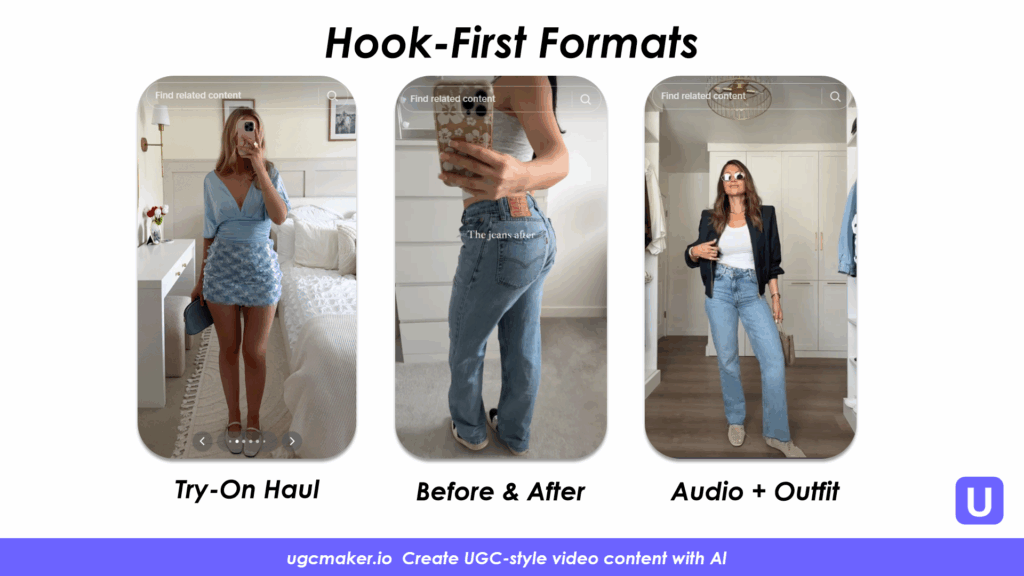
1. The Try-On Haul
A creator reacts in real time to multiple pieces, calling out what fits and what they're keeping. SHEIN built its strategy here: #sheinhaul passed 15B TikTok views, and SHEIN funds creators to run paid haul content as Spark Ads identical to organic posts. It works because hauls drive long watch time and show fit across an entire collection, the closest thing to a digital dressing room. Hook: "I ordered $200 of [brand] to see if it's worth it, here's everything." To recreate: brief a creator to order 6–8 pieces and give an honest reaction to each, including ones that don't work, the honesty is what sells the rest.
2. The Before & After Outfit Transformation
Starts in a "problem" outfit, cuts to a fully styled look. Levi's #InMyDenim campaign used this to generate massive UGC volume by pairing a clear visual format with a participation mechanic. The before/after arc is psychologically satisfying and shows value rather than describing it. Hook: "This is what I looked like before I figured out how to dress myself." Keep the "before" relatable and the "after" aspirational but achievable.
3. The Trending Audio + Outfit Transition
A quick outfit reveal synced to a viral sound, beat drop, or lyric cue. Zara and H&M time creator drops to trending audio, which platform algorithms distribute more aggressively, making it one of the most cost-efficient reach formats available. The transition itself is the product demo. To recreate: identify a trending sound and brief creators within 48 hours, trending audio windows close fast.
Category 2 — Trust Builders
4. The Honest Review
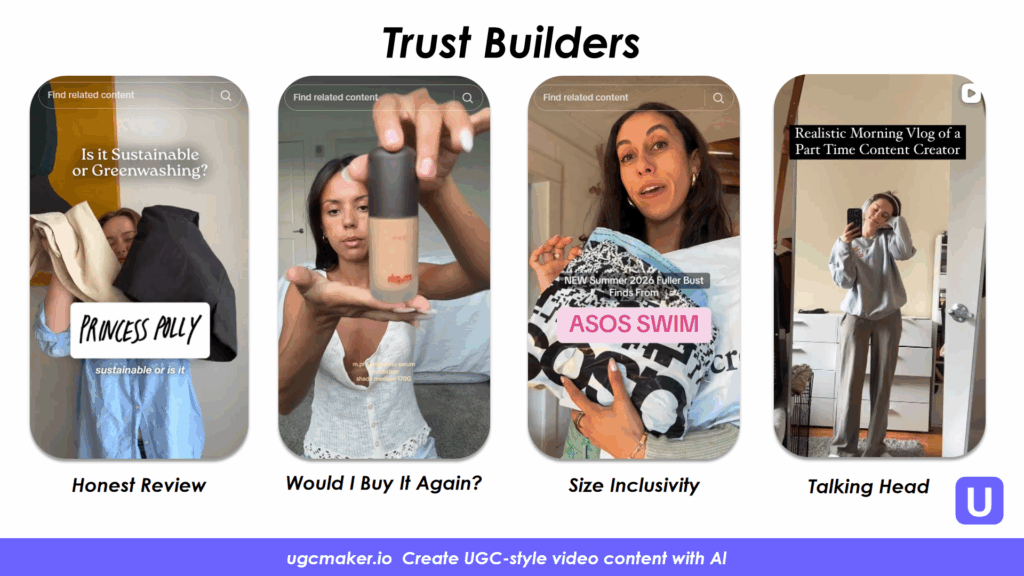
A to-camera review covering expectations vs. reality and sizing. Princess Polly's UGC includes lines like "the fabric is thinner than I expected, but I don't mind", transparency that converts because 92% of consumers trust peer recommendations over brand messaging. Hook: "I've been burned by online clothing brands before, so I'm being completely honest about this one." Give creators no talking points beyond your product specs, and don't reject content for mentioning a minor negative, it's often what makes the positive credible.
5. The "Would I Buy It Again?" Format
A delayed review weeks or months after purchase, showing how the piece held up. Quality-forward brands like Quince and Everlane use this since a creator saying "I've worn this 30 times and it still looks new" beats any brand copy. Hook: "I bought this [number] months ago. Here's whether it was worth it." Send product and ask creators to wait 4–6 weeks before filming.
6. The Size Inclusivity Showcase
Multiple body types and sizes wearing the same piece. ASOS runs this across sizes XS–3XL; one denim brand saw a 45% CTR lift and 28% higher conversion after launching it, since sizing anxiety is a top cause of cart abandonment. Hook: "I'm a size [X] and here's what it actually looks like on me." To recreate: source creators across 4–6 size ranges and run each video as a separate ad set targeted to the matching audience segment.
7. The Testimonial Talking Head
Direct-to-camera product praise that transfers from organic to paid without changes. Quay Australia and Girlfriend Collective run these as primary conversion-stage ads because eye-contact delivery creates a parasocial connection that brand copy can't. Hook: "Okay, I need to talk about this jacket because I've gotten three compliments on it today." Keep the script loose, a bullet structure (problem → discovery → purchase → recommendation) delivered in the creator's own words reads as genuine; a forced script reads as an ad.
Category 3 — Lifestyle & Aspiration
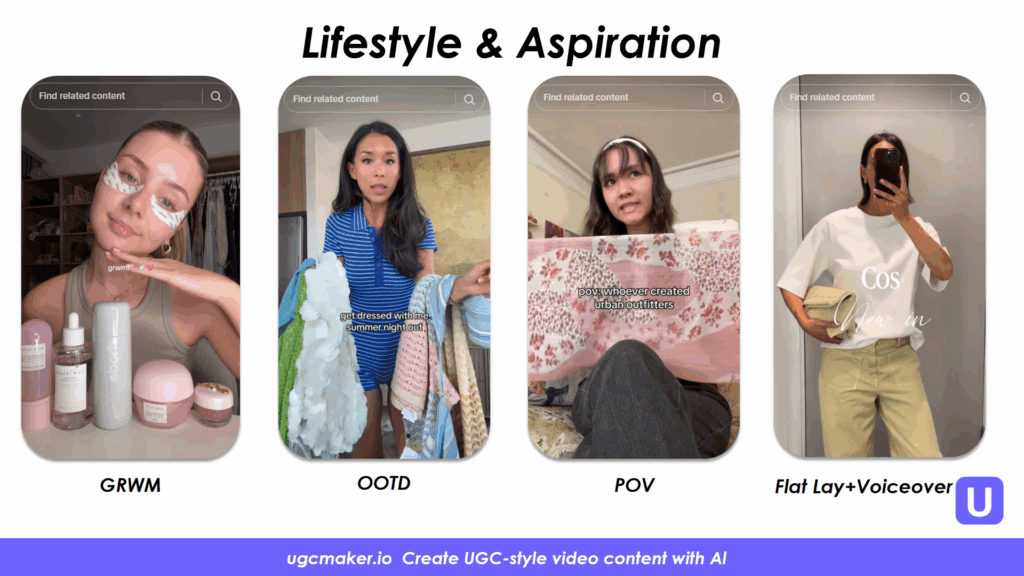
8. The GRWM (Get Ready With Me)
Clothing appears naturally inside a getting-ready routine. Revolve and Free People lean on this because purchase intent becomes a byproduct of wanting to share the creator's aesthetic, not a direct ask, which makes it strong for upper-funnel awareness and mid-funnel retargeting alike. Hook: "Getting ready for [relatable event], watch the full transformation." Ask creators to just wear the piece and go about their morning, rather than holding it up and describing it.
9. The OOTD Reel
A full outfit shown with quick styling shots, a spin or walk, and text overlays naming each item. Madewell and Anthropologie use it as standard paid creative since it doubles as visual merchandising and shopping guidance, reducing friction between "I want that" and "I know what to search for." Hook: "Outfit details below, all under $[price point]." Match creators' personal aesthetic to your brand's positioning; a streetwear creator's OOTD looks nothing like a cottagecore brand's.
10. The POV Ad
Puts the viewer inside a relatable scenario ("POV: you finally found a brand that fits"). Urban Outfitters and & Other Stories use this for relatable shopping pain points; specificity is the targeting mechanism, the more specific the scenario, the more intensely it resonates with the person it's built for. Hook: "POV: You finally found the one piece that makes every outfit work." Write the POV around a customer problem, not a product feature.
11. The Aesthetic Flat Lay + Voiceover
An overhead or side-angle product shot with a creator voiceover on quality and styling possibilities. COS and Toteme use it for premium lines, since fabric texture and construction read better in a still or slow-pan shot than a quick try-on clip. Hook: "I've been wearing this every other day for three weeks. Here's why it's worth the price." Brief creators on key quality details, fabric weight, construction, care, and let them build the voiceover around their own experience, not marketing language you've written for them.
Category 4 — Education-First Formats
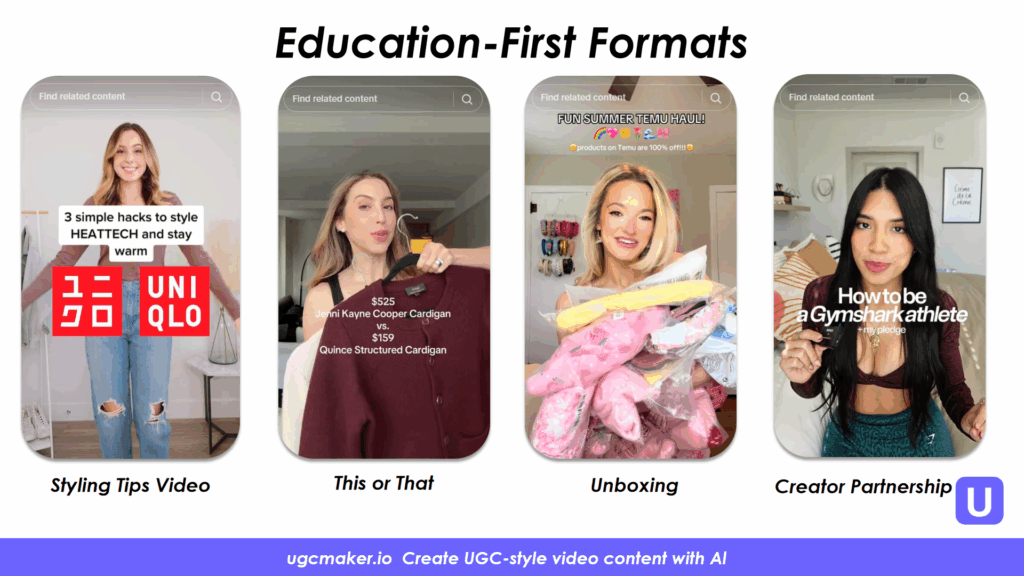
12. The Styling Tips Video
One piece styled multiple ways across different occasions. Uniqlo uses this for core items like Heattech, turning a single purchase into a versatile wardrobe investment that justifies a higher price point, and the multiple looks naturally generate longer watch time. Hook: "Three ways to style [product], one outfit for every scenario." Brief creators with a specific styling challenge, three outfits for three occasions using one piece as the anchor, and give them access to your full collection to build around it.
13. The "This or That" Comparison
A creator compares your product against a competitor or a "before" alternative. Quince has used "cashmere vs. a $300 designer option" comparisons to build credibility through contrast rather than claims, and the format generates comments that extend organic reach. Hook: "I bought both. Here's which one is actually worth it." Brief creators honestly, compare on whatever dimension you genuinely win, not on areas where your product doesn't compete.
14. The Unboxing + First Reaction
Real-time opening, reveal, and immediate try-on. Temu has run this at massive scale, generating hundreds of millions of views, because the reveal moment captures the exact instant a customer learns whether their online purchase gamble paid off. Hook: "My [brand] order finally came. Let's see if it was worth the wait." Ask creators to film without watching any other brand content first, the first impression is the asset.
15. The Creator Partnership Post
A long-term relationship where the brand becomes part of a creator's genuine style narrative rather than a one-off sponsored post. Gymshark's #Gymshark66 challenge generated 200M+ views this way, and its best-performing organic creator content then gets boosted as Spark Ads, so the paid ads are already proven by organic data. Repeated exposure builds credibility a single sponsored video can't: by the 16th video, the purchase CTA feels like a natural recommendation rather than an ad. Start with 3–5 micro-creators and offer 3-month content agreements instead of one-off posts.
TikTok vs. Instagram: Where Should You Run Each Format?
TikTok Strategy: Raw & Native
- The Vibe: Lo-fi, fast-paced, and entertainment-first. Content must look raw and native to the platform.
- Top Formats: Try-On Hauls, Honest Reviews, POV Ads, and Trending Audio Transitions.
- The Algorithm: Heavily favors watch time and shares. Formats with strong hooks punch above their weight in organic reach.
- Best Paid Format: Spark Ads. Boosting existing creator content rather than running separate ad units allows comments, likes, and social proof to carry over, giving the ad immediate credibility.
- Creator Strategy: Hire nano-influencers (1K–10K followers). They deliver a massive 10.3% engagement rate, far outperforming mega-influencers who rarely break 2%. (A niche creator with 8K followers will typically beat one with 800K).
Instagram Strategy: Aspirational & Shoppable
- The Vibe: Aspirational personal content. Audiences tolerate slightly higher production quality than TikTok, but it should never look "branded."
- Top Formats: OOTD Reels, Aesthetic Flat Lays, GRWM videos, and Creator Partnership Posts.
- Platform Strength: Its direct shopping infrastructure. Shoppable Reels and Instagram Shopping reduce the purchase journey to just two taps.
- Funnel Focus: Highly effective for lower-funnel creative—perfect for giving audiences who already know your brand that final nudge to buy.
Ad Placement Breakdown
- Reels (Discovery): Your primary UGC slot. The algorithm distributes Reels beyond your follower base, driving top-of-funnel reach that Feed posts can't match.
- Stories (Urgency): Best for limited-time offers and tight CTAs targeting warm audiences. Keep it short and punchy (e.g., "This is $40 and it's going fast" beats a 60-second review).
- Feed (Proven Winners): The destination for your best UGC after it has proven itself. Run your top-performing Reels or aesthetic flat lays here with a direct purchase CTA.
How to Source UGC for Your Clothing Brand
Micro-creators (under 50K followers) are the most cost-effective route in 2026. Brands now partner with micro-influencers ten times more often than mega-influencers, since smaller creators deliver roughly 20% higher conversion rates and produce content that reads as more authentic to their audience. Find them by searching relevant hashtags (#ootd, #fashionhaul, #styletok, #sustainablefashion) and prioritizing engagement quality over follower count, 10,000 followers with a 6% engagement rate beats 100,000 with 0.5%. Outreach is simple: send a DM, offer product-for-content or $100–$300 for a nano-creator video, and request paid usage rights.
Existing customers are often your best, and cheapest, source, since your most genuine UGC creators are already buying your clothing; the challenge is capturing their content at scale. Post-purchase email flows offering a discount for a branded-hashtag post, packaging inserts with a QR code linking to a submission form, or loyalty credit for UGC submissions typically convert 5–15 out of every 100 customers into content creators, building a continuously refreshed library with no content brief required, customers simply film what they actually think, which is often more useful than anything a briefed creator produces.
UGC sourcing platforms remove friction when you need volume fast.
UGC Maker is an AI-powered UGC platform that helps brands generate creator-style video ads at scale. It's best for ecommerce and clothing brands looking to rapidly test ad hooks, scale proven creatives, and drastically cut content production costs without sacrificing native authenticity.
Billo is a self-serve marketplace where brands post briefs and receive videos in 5–7 days, from $99/video, best for quick volume without much management overhead, though the creator pool skews general-lifestyle.
Minisocial is a fully managed service pairing brands with vetted micro-influencers who both produce and post content, from roughly $2,500 for about 10 creators, best for established D2C brands wanting licensed UGC plus organic reach.
Trend.io connects brands with Instagram- and TikTok-style creators at stronger aesthetic quality, typically $200–$2,000 per project.
Collabstr is a browse-and-book marketplace with transparent pricing, well suited to small and emerging brands testing UGC for the first time.
How to Turn Raw UGC Into a Paid Ad
Editing for paid placement without killing authenticity
The most common mistake brands make is over-editing the source material. A creator's video that converts at 4% ROAS as a Spark Ad can drop to 1.5% if you cut it into a polished ad unit with branded intros and music overlays. The general rule is to do less: trim the beginning to sharpen the hook and the end to tighten the CTA, add a text overlay with your brand name and price if the creator didn't include one, and keep the creator's original audio and natural pace. If you need captions for accessibility, use a clean, minimal font, nothing that signals "brand video."
Licensing and usage rights
Before running any UGC as a paid ad, you need explicit written permission from the creator for paid advertising usage. This is non-negotiable, legally and practically, running a creator's video as a paid ad without a usage rights agreement creates real legal exposure. Build paid usage rights into your creator agreements upfront: specify the platforms (TikTok, Meta), the duration (typically 6–12 months), and whether the content runs under the creator's handle (Spark Ads / Partnership Ads) or your brand's. Rights for creator-handle placement command a higher fee, typically 20–40% above the base content fee, but are worth it for the social proof and authenticity they preserve.
A/B testing your UGC creatives
Test systematically rather than randomly. Start with hooks, the first three seconds of each creative, isolated as a variable, since the same middle and CTA can perform very differently depending on the opening line. Once you've identified your strongest hooks, test format: does a haul or a talking-head review convert better for your specific product and audience? After format and hook, test creator demographics against audience segments, a size-inclusivity video from a size-14 creator will likely outperform a size-2 creator's video when targeted to a plus-size segment, but you need to test to confirm. Use Meta's Advantage+ Creative or TikTok's Smart+ to automate combination testing once you have a library of 6–10 validated creatives.
Frequently Asked Questions About UGC Clothing Ads
How much does UGC content cost for a clothing brand?
UGC video production averages $100–$500 per video, compared to $200–$25,000+ for traditional influencer posts depending on creator tier, making UGC 30–80% cheaper than influencer marketing while often delivering stronger conversion performance. At the platform level, running a UGC creative as a Spark Ad or Partnership Ad carries the same CPM and CPC structure as any other paid ad; the cost advantage is in production, not media buying. Looking to streamline your production process? Check out our guide to the best UGC tools to scale your creatives
Can small or independent fashion brands run UGC ads?
Yes, and small brands often outperform large ones in this format, since UGC's authenticity is a leveler. A creator with genuine enthusiasm for a small independent brand often produces more convincing content than one following a brief from a major retailer. Start with 3–5 micro-creator partnerships, put $500–$1,000 in media spend behind your strongest creative, and scale based on what the data shows. Many small fashion brands run effective UGC campaigns on $2,000–$5,000 monthly budgets. Try some tools like UGC Maker to help you produce UGC ads.
What's the ideal video length for a UGC clothing ad?
On TikTok: 15–30 seconds for hook-first formats (transitions, POV, haul highlights), 30–45 seconds for reviews and testimonials where depth adds credibility. On Instagram Reels: 15–30 seconds performs best for discovery and awareness, while 30–60 seconds suits retargeting audiences who already know the brand. Stories on both platforms: under 15 seconds for direct-response CTAs.
What's the difference between UGC ads and influencer marketing?
The core difference is what you're paying for. With influencer marketing, you pay for access to an existing audience, the influencer's followers. With UGC, you pay for content assets that you own and can run as paid ads wherever you choose. UGC creators produce content; influencers distribute it. Many sophisticated clothing brands run both: influencers for upper-funnel awareness, and UGC creative for conversion-stage paid ads retargeting the audiences influencer content reached.