

Consumers trust other people far more than they trust brands. Nielsen's long-running Global Trust in Advertising research has repeatedly found that recommendations from people, friends, family, or everyday customers, are trusted more than almost any paid advertising format, with figures in the high-80s to low-90s percent range across different survey years. That single fact is why UGC style ads, ads that look and feel like real customer content, have become one of the highest-performing creative formats in ecommerce advertising today.
This guide covers what UGC style ads are, why they work, the different formats you can use, and, because this is now genuinely possible, how AI lets any store create them without hiring a single creator.
Key Takeaways
- UGC style ads are ads that mimic the look and feel of authentic, user-created content, regardless of who actually made them.
- Ads that use UGC or a UGC style see meaningfully higher click-through rates and lower cost-per-click than standard brand-produced creative ().
- There are three ways to get UGC style ads: partner with creators, repurpose real customer content, or generate them with AI.
- AI-generated UGC style ads now let small and mid-size ecommerce sellers produce this format in minutes, without a creator budget, though platforms like Meta and TikTok require you to disclose when content is AI-generated.
- Getting the format right matters more than the production method: authenticity, a clear hook, and a strong CTA drive performance regardless of how the video was made.
Data Source: Nielsen, Bazaarvoice
What Are UGC Style Ads?
It's worth separating two terms that get used interchangeably but aren't quite the same thing.
UGC (user-generated content) refers to content that was actually created by a real customer or user, an unprompted review, an unboxing clip, a photo someone posted on their own.
UGC style ads are advertisements that adopt the look and feel of that kind of content, handheld camera work, casual delivery, a real person talking to the camera, regardless of whether the person in the ad is an actual customer, a paid creator, or a fully AI-generated presenter. The defining trait isn't authorship; it's the authentic, unpolished aesthetic that signals "this isn't a scripted brand ad."
That distinction matters because it's the reason AI-generated UGC style ads work at all: viewers are responding to the format and tone, not to a verified chain of custody proving a real customer filmed it.
Why UGC Style Ads Work
The performance case for UGC style ads is well documented by independent research, not just vendor marketing claims:
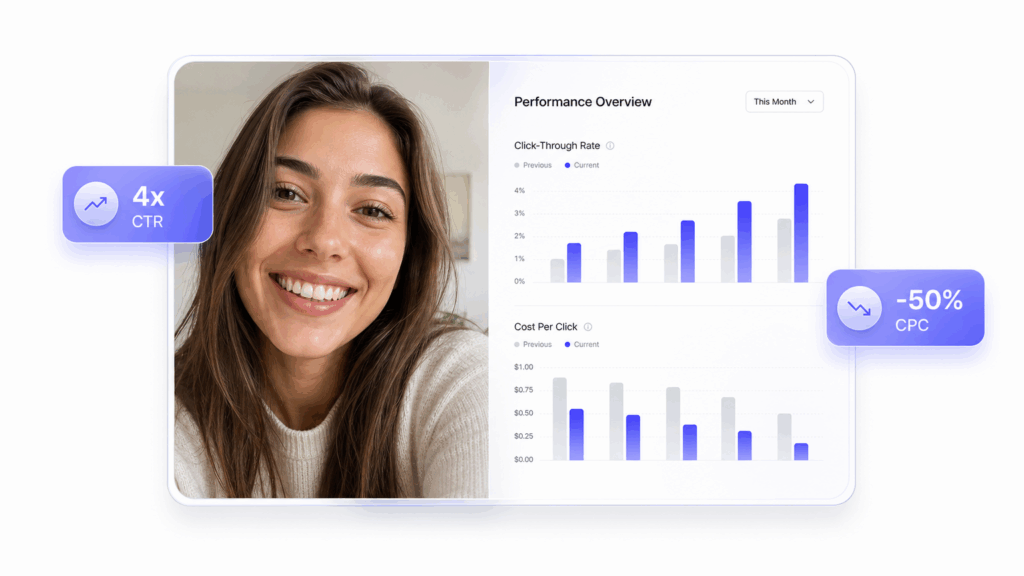
- Ads that incorporate UGC or a UGC style see roughly 4x higher clickomy**-through rates** than standard brand-produced ad creative
- The same research found UGC-based ads can reduce cost-per-click by around 50% compared to ads using only brand-created assets
- On product pages specifically, adding UGC has been associated with substantially higher conversion rates compared to pages using only brand-created content .
- At the trust level, Nielsen's advertising research consistently ranks recommendations from real people above every paid advertising format it tracks, including TV, search, and display.
The mechanism behind all of this is simple: shoppers have learned to filter out anything that looks like a traditional ad. A UGC style format doesn't trigger that filter in the first second or two, which is often the only window you have to earn attention on a feed.
Data Source: Nielsen, Bazaarvoice
Anatomy of a High-Converting UGC Style Ad
Not every video that looks casual actually converts. The ones that do tend to share five characteristics.
1. Genuine, Unpolished Delivery
The best-performing examples avoid a scripted, salesy tone. Natural pauses, casual phrasing, and imperfect lighting all signal authenticity, over-polishing a UGC style ad often undermines the exact thing that makes the format work.
2. Clear Product Visibility
The product needs to be visible and identifiable early. Ads that bury the product behind a long personal story tend to lose viewers before the pitch even starts.
3. A Fast, Specific Hook
The first 1–3 seconds decide whether someone keeps watching. A specific, relatable problem statement outperforms a generic opener nearly every time.
4. Real Structure Underneath the Casual Tone
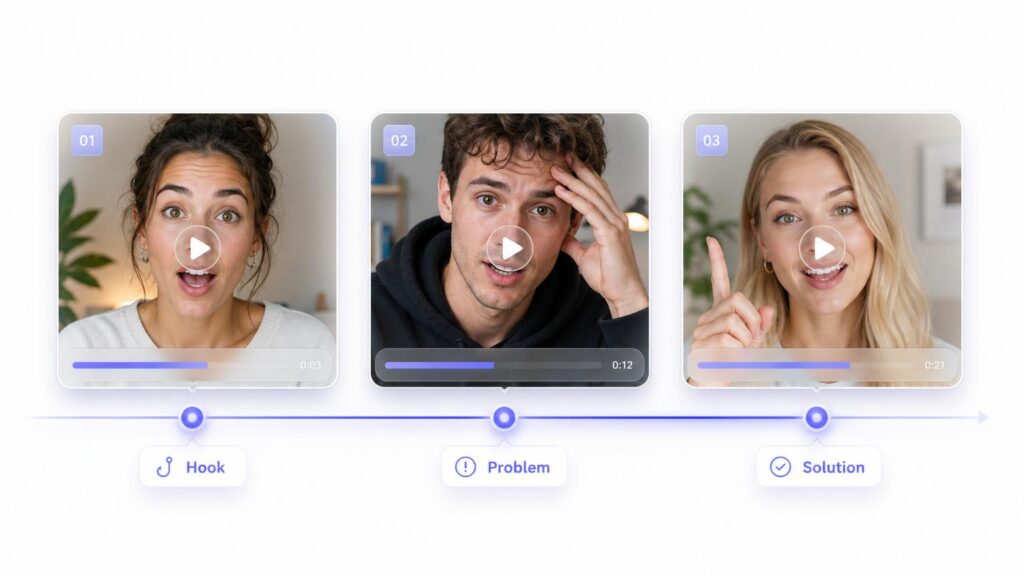
"Unscripted" doesn't mean unstructured. The strongest UGC style ads still follow a simple arc: hook → problem → product as solution → proof or result → CTA.
5. An Explicit Call to Action
Because the format feels informal, it's easy to forget the ad still needs to close. Every UGC style ad should end with a specific, unambiguous next step, not just a vague "check it out."
Types of UGC Style Ads
Testimonial-Style Ads
A single presenter talks directly to camera about their experience with the product. This format works best for products with a clear, describable benefit (skincare results, a productivity tool, a supplement).
Before-and-After Ads
Two moments, the problem state and the improved state, shown side by side or in sequence. Effective for visually demonstrable transformations, but be careful: some platforms restrict before-and-after claims for certain categories, which we cover in the compliance section below.
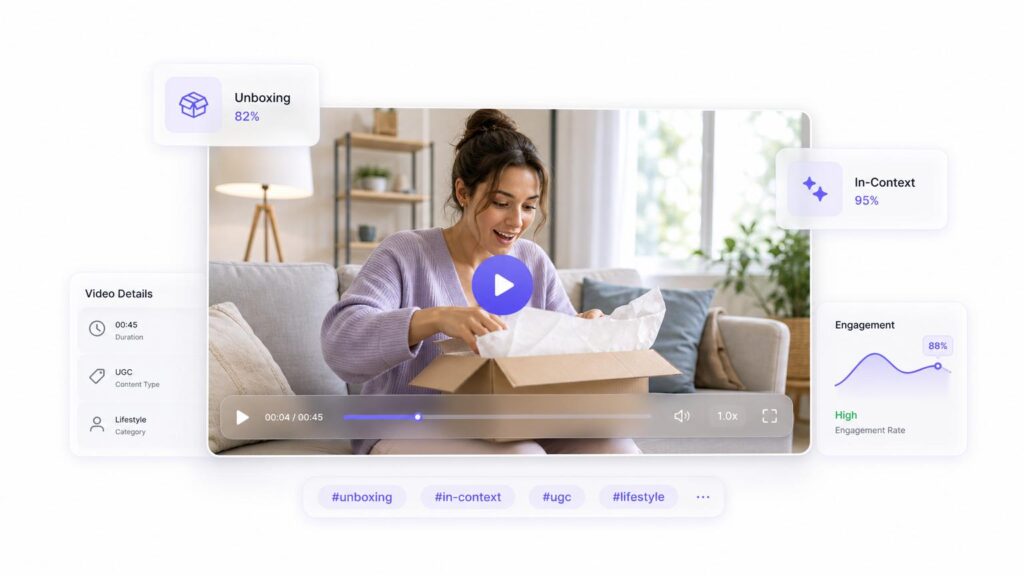
Unboxing Ads
The presenter opens the package on camera, reacting in real time. This format leans on curiosity and anticipation rather than a spoken pitch, and tends to perform well for physical products with strong packaging or a "reveal" moment.
Tutorial / How-To Ads
The presenter demonstrates how to use the product, folding education into the pitch. This works particularly well for products that need a bit of explanation before a shopper will trust them.
In-Context / Day-in-the-Life Ads
The product appears naturally within a broader scene, getting ready in the morning, at the gym, at a desk, rather than being the sole focus of the shot. This format tends to feel the least "ad-like" of all the types listed here.
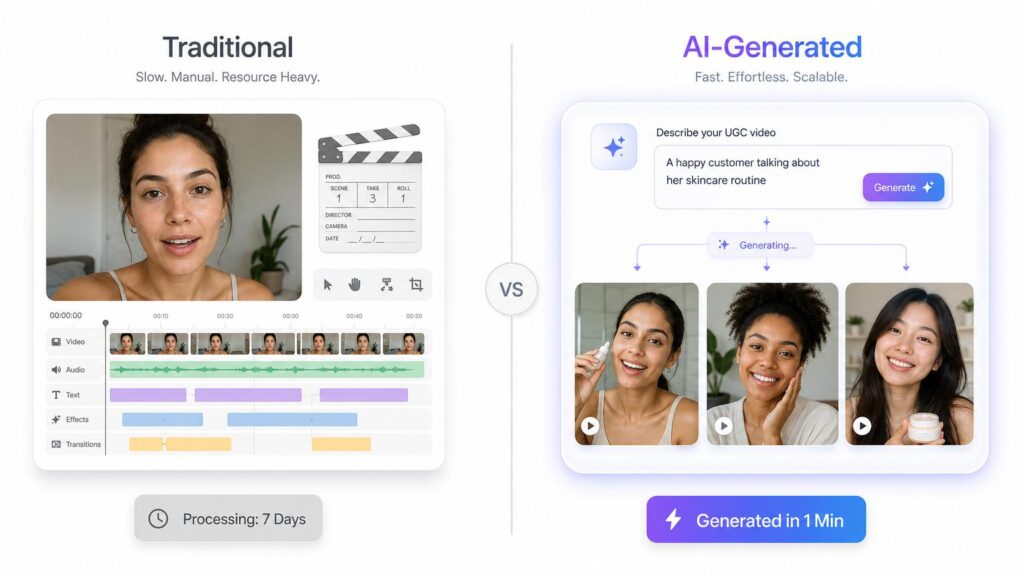
Traditional Creator UGC vs AI-Generated UGC Style Ads
| Creator-Sourced UGC | AI-Generated UGC Style Ads | |
| Turnaround time | Days to weeks (briefing, filming, revisions) | Minutes to hours |
| Cost per video | Typically requires a creator fee plus usage rights | Fraction of the cost, scalable across a full catalog |
| Scalability | Limited by creator availability and budget | Can generate variants for every SKU or audience segment |
| Localization | Requires separate shoots or re-recording per market | Can produce multiple language versions from the same product and avatar, without separate shoots per market |
| Rights and legal clearance | Requires signed usage and likeness agreements | No creator likeness rights to negotiate, but platform AI-disclosure rules still apply |
| Emotional nuance | Real lived experience, harder to fully replicate | Improving quickly, but highly specific personal storytelling can still be harder to match |
Neither column is universally "better", the honest takeaway is that AI-generated UGC style ads are strongest for speed, volume, and localization, while creator-sourced UGC still has an edge for deeply personal, highly specific testimonial storytelling. Most performance marketers now use a mix of both. Tools like Marketing Studio make it easy to test both approaches without committing to one workflow.
How to Create UGC Style Ads with AI
Here's what the workflow actually looks like in a tool like Marketing Studio, which is built around two uploads, a product photo and an avatar, rather than a written creative brief.
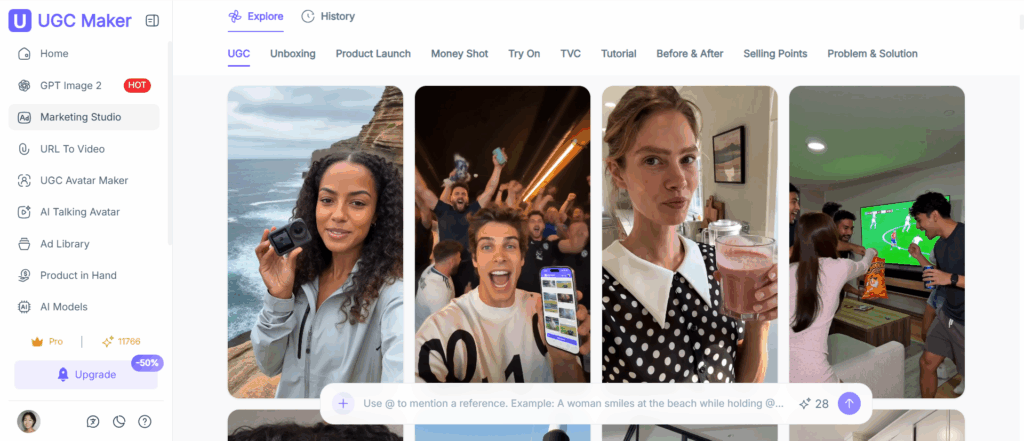
Step 1: Pick a Format
Start by choosing a preset ad format: UGC, Unboxing, Product Launch, Money Shot, Try On, TVC, Tutorial, Before & After, Selling Points, or Problem & Solution. These map closely to the ad types covered earlier in this guide, Before & After for transformation-style content, Tutorial for how-to content, Unboxing for the reveal format, and so on, and each preset applies its own camera framing and pacing automatically.
Step 2: Upload Your Product and an Avatar
Add a product photo and an avatar, either your own model's photo or one generated separately with an avatar tool. These two uploads are what the chosen format actually builds the scene around; there's no filming and no product shipping involved.
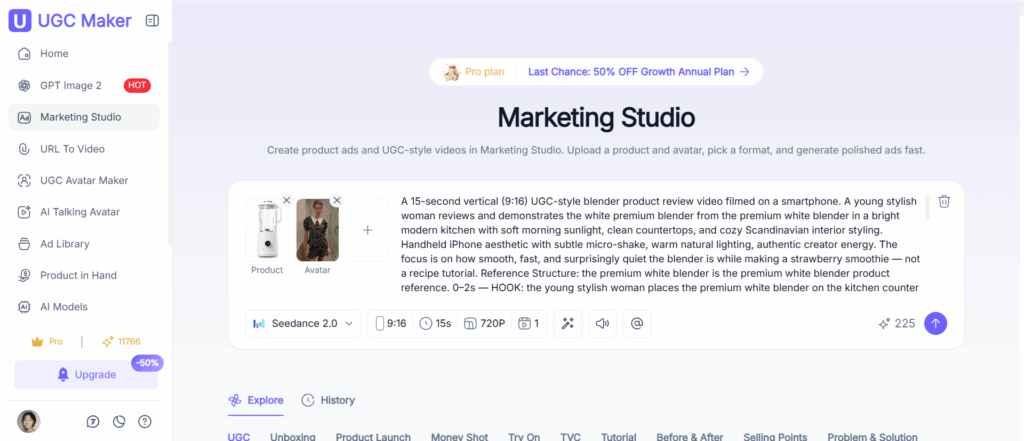
Step 3: Describe the Scene, or Use a Suggested Prompt
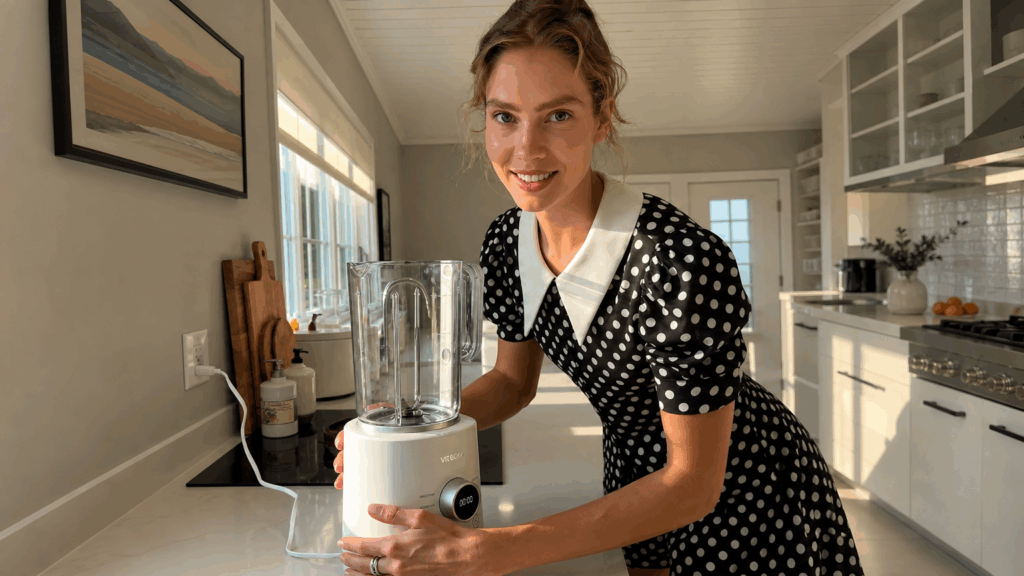
Reference your uploads directly in the prompt using @Product and @Avatar tags, for example, "@Avatar unboxes @Product on a kitchen counter", or click one of the ready-made prompt suggestions offered for your chosen format if you'd rather not write one from scratch. This is the point to check that whatever the scene implies about the product is something you can actually stand behind, the same claim discipline that applies to a written script.
Step 4: Generate, Preview, and Regenerate
Generate the video, preview it, and download it once you're happy with the take. If the pacing or framing isn't quite right, regenerating with the same product, avatar, and format is fast enough to treat this as a real testing loop rather than a one-shot output.
If you're starting from just a product link rather than product photos, a URL-based tool can pull the visuals in first, which you can then bring into this same workflow. And if a format needs spoken dialogue in a specific language for a given market, that's handled through a dedicated avatar/voiceover tool rather than this workflow directly.
Best Practices for UGC Style Ads That Convert
- Write for silence. A large share of Facebook and TikTok video is watched without sound, so captions and on-screen text need to carry the message on their own.
- Test multiple hooks against the same body. The first line is usually the single biggest lever on performance, testing 3–5 hook variants against one script is often more efficient than testing entirely different concepts.
- Keep the CTA specific. "Shop now" outperforms vague prompts like "check it out" because it tells the viewer exactly what to do next.
- Match the video length to the platform. Shorter, tighter cuts tend to hold attention better on TikTok and Reels than repurposed long-form content.
- Run structured A/B tests. Isolate one variable at a time, hook, avatar, or CTA, so you can actually attribute a performance change to a specific creative decision.
Legal and Compliance Considerations
This is the section most UGC ad guides skip, and it's become more important, not less, as AI-generated creative has scaled.
Meta (Facebook and Instagram)
Meta applies an "AI info" label to ads that are created or significantly edited with generative AI, including content made with its own tools or with third-party AI tools like the ones used to produce UGC style avatars. The label can appear next to the "Sponsored" tag or inside the "About this ad" menu, and it is applied automatically when Meta's systems detect AI involvement, including through embedded C2PA metadata (Meta Help Center; Meta's official announcement). Minor edits like color correction or cropping don't trigger the label, but a fully AI-generated presenter or a significantly AI-edited product video does.
TikTok
TikTok's policy is more explicit and mandatory. Under TikTok's advertising policy on misleading and false content, ads containing content that has been significantly created or altered by AI must carry disclosure, either through TikTok's AI-Generated Content (AIGC) label, or through a clear disclaimer, caption, watermark, or sticker added by the advertiser (TikTok Ads Policy). Separately, TikTok Shop's content guidelines state that AI-generated content is permitted as long as it doesn't misrepresent the product or replace an accurate product display, and that creators should disclose when content is fully or significantly AI-generated (TikTok Seller Center).
General Truth-in-Advertising Rules
Regardless of platform-specific labeling rules, UGC style ads are still subject to standard advertising law: claims need to be substantiated, and testimonials should reflect an honest representation of typical results. This applies whether the presenter is a real customer, a paid creator, or an AI-generated avatar, an avatar cannot make a first-person experiential claim ("I've used this every day for a month") that didn't actually happen.
Platform policies change frequently. Before launching a campaign, confirm current requirements directly on Meta's and TikTok's official advertising policy pages, since specific thresholds and label placements are updated periodically.
Real Examples
These results come from published case studies of brands running UGC style ads (creator-sourced, in these cases) rather than generic vendor claims, a useful reality check on what the format can actually do, regardless of whether the video was filmed by a creator or generated with AI.
Flex Mobile used UGC-style testimonial ads to cut customer acquisition cost from over $220 down to consistently under $75, a roughly 66% reduction, with its single top-performing testimonial video reaching a $22 CPA.
Adore Me ran UGC-style creator ads alongside its other TikTok ad creative and saw a 15% higher click-through rate and an 8% lower cost-per-acquisition compared to its non-UGC ads on the same platform.
Filterbuy used UGC-style ads across paid social and saw an 816% lift in click-through rate, with its top-performing ad reaching a 17.70% CTR.
Fresh Clean Threads made UGC-style ads its top-performing ad format entirely, hitting a 2x-plus ROAS on its Black Friday creative, outperforming every other ad type in the account.
Worth noting: even a brand in a more regulated, less obviously "UGC-friendly" category, a cybersecurity product, in Mozo's case, saw a 22% CTR lift, 83% longer average play time, and a 15% lower CPA after scaling scripted UGC-style ads and testing hooks at volume. That's a useful data point for any store selling something that doesn't feel like an obvious fit for the "casual testimonial" format, the results above suggest the format's advantage isn't limited to beauty or lifestyle products.
These figures are as published by Billo and reflect creator-sourced UGC campaigns specifically; they were not independently re-verified by ugcmaker.io. We'll update this section with AI-generated UGC style ad results once we have approved data from our own customers.
Data Source: Billo
FAQ
What are UGC style ads?
UGC style ads are advertisements designed to look and feel like authentic, user-created content, casual delivery, handheld-style visuals, and a personal tone, regardless of whether the content was made by a real customer, a paid creator, or generated with AI.
Are AI-generated UGC style ads allowed on Meta and TikTok?
Yes. Both platforms permit AI-generated ad content, but both require disclosure. Meta applies an "AI info" label automatically or via advertiser disclosure, and TikTok requires an AIGC label or an equivalent visible disclosure for significantly AI-generated or AI-edited content.
How much do UGC style ads cost to make?
Creator-sourced UGC typically involves a per-video creator fee plus usage rights, which can add up quickly across multiple SKUs or markets. AI-generated UGC style ads cost a fraction of that per video and scale more easily across a full product catalog.
UGC style ads vs traditional brand ads: what's the real difference?
Traditional brand ads are polished, scripted, and clearly produced by the company. UGC style ads intentionally adopt a more authentic, less polished format because that format is trusted more and tends to convert better, based on independent research from firms like Bazaarvoice and Nielsen.
Do I need a real customer to make a UGC style ad?
No. The format is defined by its look and feel, not by who created it. Paid creators and AI-generated avatars can both produce effective UGC style content, as long as any claims made are accurate and any required AI disclosure is applied.