


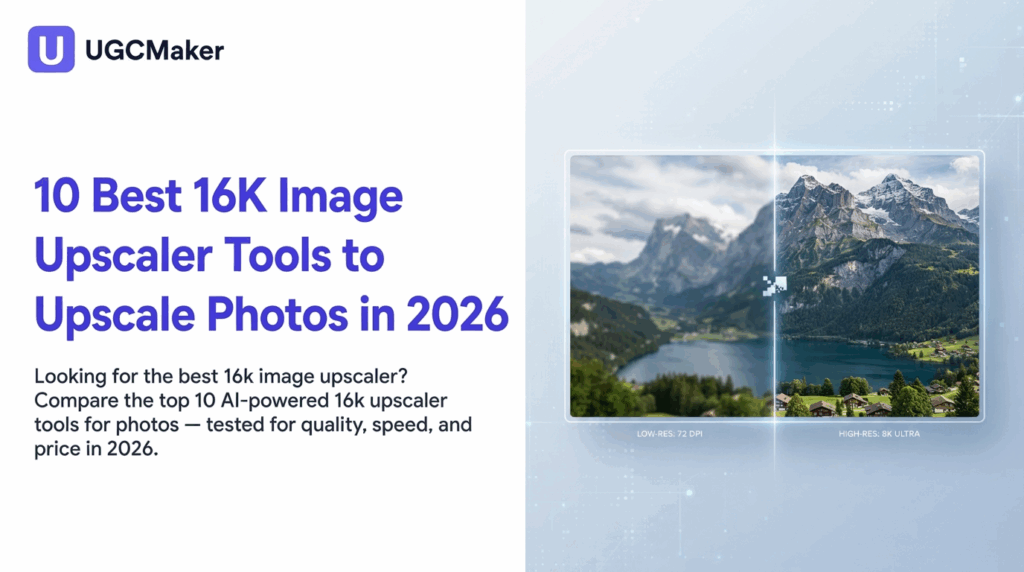
TL;DR
- A 16k image upscaler uses AI to reconstruct fine detail, not just stretch pixels — essential for large-format printing, gallery art, and oversized digital assets.
- We tested 10 tools; only a handful (UGCMaker, Topaz Gigapixel AI, VanceAI, Let's Enhance) actually reach true 16K output — several popular "AI upscalers" cap at 8K on standard plans.
- UGCMaker AI 16K Upscaler offers the best overall balance of true 16K output, batch speed, and a usable free tier — best for creators, UGC, and e-commerce assets.
- Topaz Gigapixel AI wins on raw detail recovery for professional photography, but requires a one-time purchase and strong local hardware.
- For anime/illustration work, Bigjpg and Waifu2x outperform general-purpose tools.
- Jump to the comparison table for a quick side-by-side, or the FAQ for common questions about resolution, pricing, and print use.
If you've ever tried to print a photo poster-sized, blow up a piece of digital art for a gallery wall, or prepare a hero image for a giant e-commerce banner, you already know the problem: most photos simply don't have enough resolution. That's where a 16k image upscaler comes in.
Unlike basic resizing, a good AI-powered 16k upscaler doesn't just stretch pixels — it reconstructs detail, sharpens edges, and fills in texture that was never captured by the original camera. In this guide, we tested the top 10 tools that claim to handle 16k upscale image jobs, comparing them on output quality, processing speed, and pricing so you can pick the right one for your workflow.
What Is a 16K Image Upscaler?
16K resolution refers to an image with roughly 15,360 × 8,640 pixels — about 4x the pixel count of 4K and 16x that of standard 1080p. For context, most smartphone photos top out well below this, and even professional DSLR shots usually need significant upscaling to reach true 16K dimensions.
An image upscaler 16k tool uses AI models (typically based on super-resolution neural networks or generative diffusion techniques) to intelligently add pixels rather than just duplicating or blurring existing ones. The best tools can take a modest 2MP snapshot and turn it into a crisp, print-ready 16K file — a process often described as 16k enhance photo conversion.
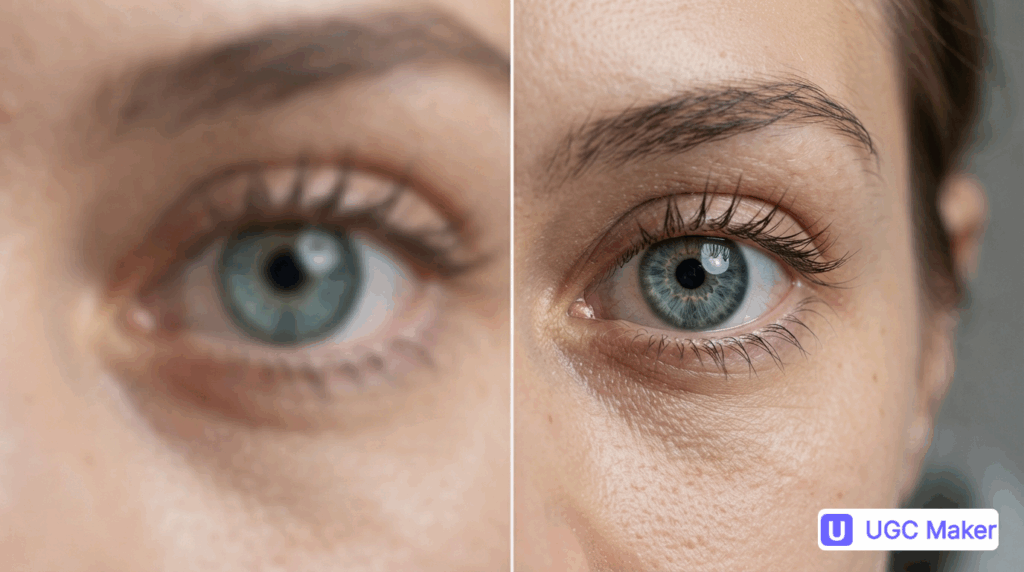
This is fundamentally different from the "resize" feature in Photoshop or a phone gallery app. Traditional interpolation just guesses pixel values based on neighbors, which quickly looks soft or blocky at extreme scales. AI upscalers instead recognize patterns — skin texture, fabric weave, foliage, hair strands — and reconstruct plausible detail, which is why they can push all the way to 16K without turning the image to mush.
Who Needs 16K Image Upscaling?
Not everyone needs to go all the way to 16K, but for certain use cases it's essential:
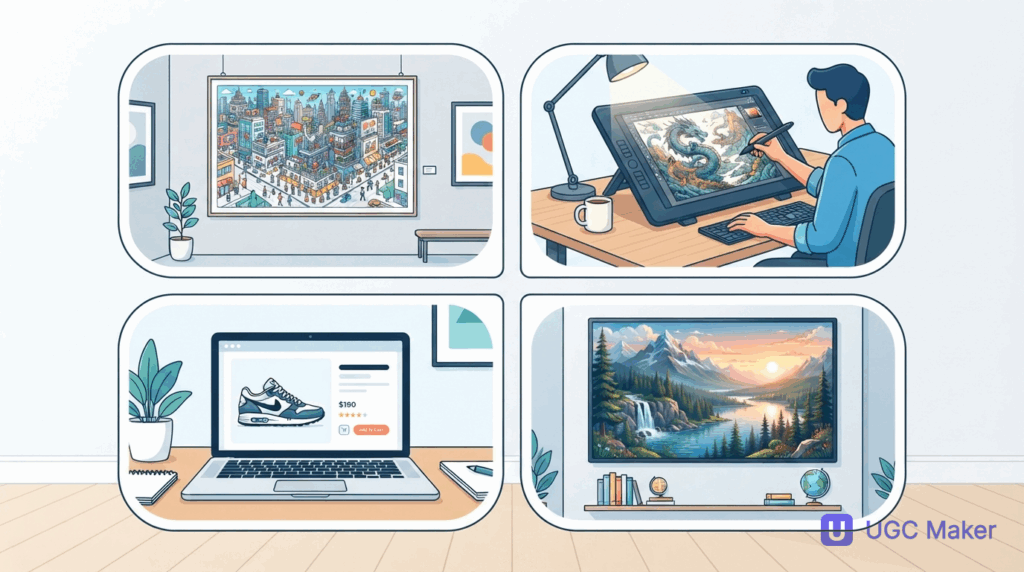
- Large-format printing — posters, banners, billboards, and gallery prints all demand extreme resolution to avoid visible pixelation up close.
- Digital artists and illustrators — upscaling sketches or AI-generated art for high-res portfolio pieces or print-on-demand products.
- Photographers — recovering detail from older or lower-resolution archives before printing or licensing.
- E-commerce and UGC creators — producing oversized hero images, zoomable product shots, or background assets for video and social content.
- Wallpaper and background designers — creating ultra-sharp assets for large displays, digital signage, or 8K/16K monitors.
If any of these sound like you, a dedicated 16k upscaler will save hours compared to manual retouching.
Top 10 Best 16K Image Upscaler Tools in 2026
We tested each tool on the same batch of source images — a portrait, a landscape photo, and a piece of digital line art — and evaluated how each handled fine detail, color accuracy, and processing time at maximum output resolution. Here's the quick-reference comparison, followed by a closer look at each tool.
| Tool | Key Features | Max Upscale | Pros | Cons | Best For | Pricing |
| UGCMaker AI 16K Upscaler | AI detail reconstruction, batch processing, UGC/social asset presets, one-click export | 16K | True 16K output, fast batch mode, built for creators | Advanced controls need a short learning curve | Creators, UGC & social content, e-commerce | Free tier + paid plans |
| Topaz Gigapixel AI | Face recovery, noise reduction, desktop app | 16K (with tiling) | Excellent fine-detail preservation | Requires a powerful local machine, one-time cost | Professional photographers | One-time purchase |
| Let's Enhance | Cloud-based, bulk upload, format presets | 8K–16K (plan-dependent) | Simple web interface, good for batches | Higher tiers needed for max resolution | Small business, product photos | Free tier + subscription |
| Bigjpg | Anime/illustration-focused AI model | 8K–16K (multi-pass) | Great for line art and anime | Less effective on real photos | Illustrators, anime fan art | Free with credits |
| Waifu2x | Open-source, lightweight, anime-optimized | Limited native, multi-pass to reach 16K | Free and open-source | Manual multi-pass needed for extreme sizes | Hobbyists, anime/manga art | Free |
| Remini | Mobile-first, face enhancement focus | Up to 4K–8K native | Great for old photo restoration | Not built for true 16K output | Casual users, family photos | Freemium |
| Icons8 Upscaler | Simple drag-and-drop, quick presets | Up to 8K | Fast and beginner-friendly | Caps below full 16K on most plans | Quick everyday upscaling | Free + paid credits |
| Fotor AI Upscaler | All-in-one photo editor with upscaling module | Up to 8K | Bundled with editing tools | Upscaling is a secondary feature | All-in-one editing users | Freemium |
| VanceAI | Multiple specialized AI models (photo, art, anime) | 8K–16K (tiered) | Flexible model selection | Interface can feel dated | Users who want model choice | Free trial + subscription |
| Pixelcut | Mobile & web app, e-commerce focused | Up to 8K | Fast, good for product photos | Not optimized for extreme 16K prints | E-commerce sellers | Freemium |
1. UGCMaker AI 16K Upscaler
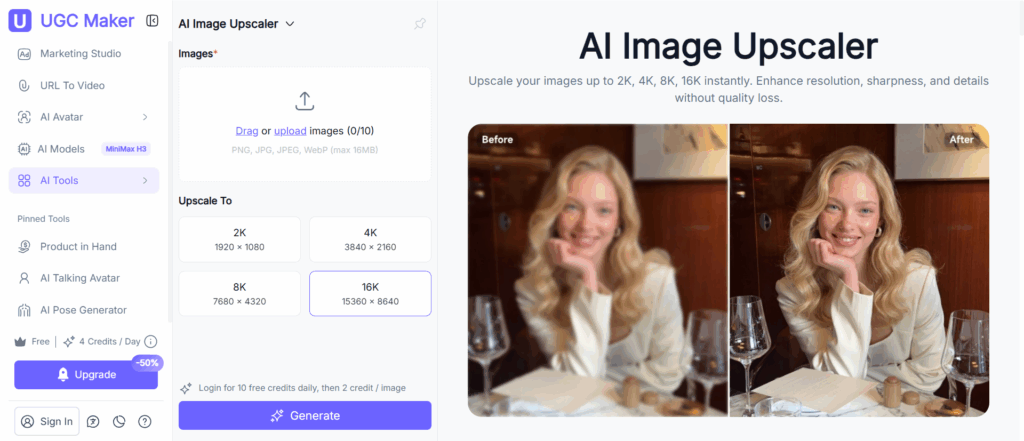
UGCMaker's upscaler is built specifically around creators who need large, clean assets fast — think social content, product visuals, and UGC-style photography.
Key Features:
- True 16K output (15,360 × 8,640) without a hidden plan cap
- Batch processing — queue dozens of images and export them in one pass
- Presets tuned for UGC, social, and e-commerce asset dimensions
- One-click export in multiple formats, ready for print or web
Max Upscale: 16K (full native resolution, not tiled or multi-pass)
Pros: UGCMaker AI 16K Upscaler genuinely reaches 16K rather than gating it behind an enterprise tier; batch mode is fast enough for content pipelines; interface is built for creators, not just photographers.
Cons: The more advanced batch and preset controls take a few minutes to learn if you're used to a bare-bones tool.
Best For: Creators, UGC pipelines, e-commerce teams, and anyone producing large volumes of social or product imagery that need to scale up cleanly.
Pricing: Free tier available for testing output quality; paid plans unlock batch limits and higher-volume exports.
2. Topaz Gigapixel AI
A long-standing favorite among professional photographers, Gigapixel AI is a desktop application known for its face-detail recovery and noise reduction.
Key Features:
- Dedicated face-recovery model for portraits
- Noise reduction built into the upscaling pipeline
- Tiled processing to reach extreme output sizes like 16K
- Batch processing via desktop app
Max Upscale: 16K, achieved through tiled processing rather than a single native pass
Pros: Consistently excellent results on portraits and fine texture; well-established in professional photography workflows.
Cons: Requires a capable local GPU to run smoothly at high resolutions; one-time purchase is a bigger upfront commitment than a subscription.
Best For: Professional photographers who need maximum control and detail accuracy, and who already work in a desktop editing pipeline.
Pricing: One-time software purchase (no recurring subscription).
3. Let's Enhance
Let's Enhance is a browser-based tool aimed at small businesses that need to batch-process product photography.
Key Features:
- Bulk upload for processing many images in one session
- Format presets for common e-commerce and web dimensions
- Cloud-based — no software install required
- Basic color and sharpness adjustment alongside upscaling
Max Upscale: 8K on standard plans; 16K available on higher-tier subscriptions
Pros: Very approachable interface, good for teams without technical staff; batch upload saves time on catalog-style work.
Cons: Full 16K output is locked behind a higher subscription tier, not available on the free or entry plan.
Best For: Small businesses and online stores batch-processing product photos.
Pricing: Free tier with limited resolution; paid subscription required for higher output sizes.
4. Bigjpg
If your source material is anime-style art or illustration rather than photography, Bigjpg's specialized model tends to outperform general-purpose upscalers.
Key Features:
- AI model trained specifically on anime/illustration-style images
- Clean line and flat-color preservation
- Multi-pass upscaling to reach very large output sizes
- Simple web-based upload and download flow
Max Upscale: 8K natively; up to 16K achievable through multiple upscaling passes
Pros: Handles clean linework and flat colors noticeably better than photo-focused tools. Cons: Noticeably weaker results when applied to real-world photographs with complex texture.
Best For: Illustrators, anime fan art, and digital artists working with line-based or flat-color art.
Pricing: Free to use with a credit-based system for higher-resolution exports.
5. Waifu2x
Waifu2x is the open-source classic in this space, still widely used for anime and manga-style images.
Key Features:
- Fully open-source, no account required
- Lightweight processing, can run locally or via free web demos
- Optimized specifically for anime/manga-style artwork
- Noise reduction option alongside upscaling
Max Upscale: Native output is more limited; reaching 16K requires running the image through multiple upscaling passes manually
Pros: Completely free and transparent, with an active open-source community. Cons: No true one-step 16K output — multiple passes are needed, which adds manual effort and can compound artifacts.
Best For: Hobbyists and anime/manga fans who want a free, no-frills tool and don't mind a manual multi-pass workflow.
Pricing: Free.
6. Remini
Remini is best known as a mobile app for restoring old or low-quality family photos, especially faces.
Key Features:
- Face-focused enhancement and restoration model
- Mobile-first app with a simple, guided flow
- Old photo restoration presets
- Quick one-tap processing
Max Upscale: Typically 4K–8K native output
Pros: Fast and very easy to use, especially for restoring old or blurry photos. Cons: Not designed to reach true 16K — output resolution tops out well below what large-format printing needs.
Best For: Casual users restoring old family photos rather than producing print-scale or gallery-scale assets.
Pricing: Freemium, with subscription unlocking full-resolution exports and extra features.
7. Icons8 Upscaler
Icons8 offers a no-frills, drag-and-drop upscaling tool that's great for quick everyday tasks.
Key Features:
- Drag-and-drop upload with instant preview
- Simple resolution presets
- Fast processing for smaller jobs
- Integration with Icons8's broader design asset library
Max Upscale: Up to 8K on most plans
Pros: Extremely approachable for beginners; minimal setup or learning curve. Cons: Doesn't reach full 16K on standard plans, limiting it for large-format use cases.
Best For: Quick, everyday upscaling tasks that don't require extreme output sizes.
Pricing: Free tier available; paid credits for higher-resolution or bulk exports.
8. Fotor AI Upscaler
Fotor bundles an upscaling module inside a broader photo editing suite.
Key Features:
- Upscaling combined with full photo editing toolkit
- Batch editing across multiple images
- Templates for social and marketing graphics
- Built-in filters and retouching tools
Max Upscale: Up to 8K
Pros: Convenient if you're already editing photos in Fotor — no need to switch tools. Cons: Upscaling is a secondary feature rather than the core focus, and resolution ceiling reflects that.
Best For: Users who want upscaling bundled with general photo editing rather than a dedicated 16K tool.
Pricing: Freemium, with premium features under subscription.
9. VanceAI
VanceAI stands out for offering multiple AI models tailored to different content types.
Key Features:
- Separate models for photos, illustrations, and anime-style art
- Batch processing support
- Adjustable enhancement strength per model
- API access on higher-tier plans
Max Upscale: 8K on lower tiers; up to 16K on higher subscription tiers
Pros: Model flexibility means you can match the AI engine to your specific content type. Cons: Interface feels a little dated compared to newer competitors.
Best For: Users who want to fine-tune which AI model handles their specific image type (photo vs. illustration vs. anime).
Pricing: Free trial available; full features require a subscription.
10. Pixelcut
Pixelcut is geared toward e-commerce sellers who need fast product photo upscaling and background cleanup.
Key Features:
- Product-photo-focused upscaling
- Background removal and cleanup tools built in
- Mobile app and web app both available
- Fast turnaround optimized for catalog-style workflows
Max Upscale: Up to 8K
Pros: Quick and mobile-friendly, integrates well into an e-commerce photo workflow. Cons: Resolution ceiling makes it less suited to true 16K, large-format output.
Best For: E-commerce sellers needing fast product photo upscaling rather than print-scale assets.
Pricing: Freemium, with paid plans for higher volume and resolution.
How We Tested These 16K Upscalers
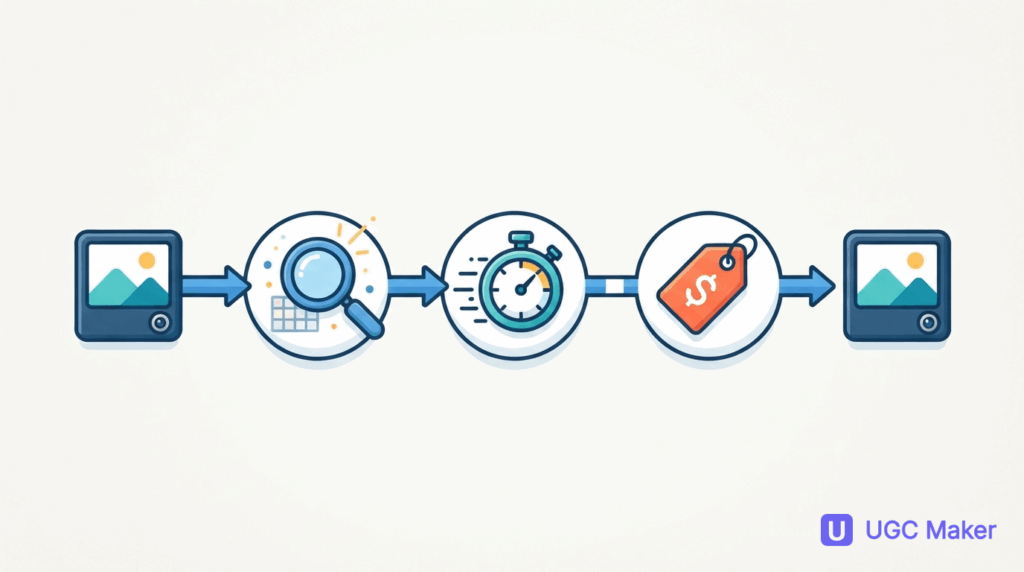
To keep the comparison fair, we ran identical source images — a human portrait, a detailed landscape, and a digital illustration — through each tool at its maximum available output size. We then evaluated:
- Detail reconstruction — how convincingly fine textures (skin, hair, foliage, fabric) held up at extreme zoom
- Edge sharpness vs. artifacting — whether upscaling introduced haloing, smearing, or unnatural sharpening
- Processing speed — time taken per image at maximum resolution
- Batch capability — whether multiple images could be queued and processed unattended
- Price-to-quality ratio — what you actually get at the free tier versus what's locked behind a paywall
How to Choose the Right 16K Image Upscaler
With so many overlapping options, here's what actually matters when picking a tool:
Actual max resolution. Many tools marketed as "AI upscalers" cap out at 4K or 8K on their standard plans — check the fine print before assuming you're getting true 16K output.
Speed vs. file size. Larger output files take longer to process and export; if you're working in batches, factor in realistic turnaround time, not just per-image speed.
Free tier limits. If you only need to upscale an occasional image, look for tools offering a workable image upscaler 16k free option before paying for a subscription you'll rarely use.
Batch and API support. For e-commerce catalogs, UGC pipelines, or agency workflows, the ability to process images in bulk (or integrate via API) is often more valuable than marginal quality differences between top-tier tools.
FAQ
What is the best free 16k image upscaler?
Several tools, including UGCMaker, Bigjpg, and Waifu2x, offer free tiers or open-source access. Free plans are usually best for testing quality or occasional single-image use rather than heavy batch work.
Can AI really upscale an image to 16K without losing quality?
Modern AI upscalers can produce impressively sharp, detailed results even at 16K, though outcomes depend heavily on the quality of the source image — a blurry or heavily compressed original will still show limitations after upscaling.
How long does it take to upscale a photo to 16K?
This varies by tool and server load, but most cloud-based upscalers complete a single 16K image in under a minute, while desktop tools depend on local hardware.
Is 16K upscaling worth it for printing?
Yes, for large-format prints, posters, or gallery pieces, 16K resolution helps avoid visible pixelation up close. For standard photo prints or social media, lower resolutions are usually sufficient.
What's the difference between 16K upscaling and 4K/8K upscaling?
The core AI technique is similar, but 16K requires significantly more processing power and tends to be more selective about which tools can maintain quality without introducing artifacts at that scale.
Final Verdict
For most creators and UGC-focused workflows, UGCMaker's AI 16K Upscaler offers the best balance of true 16K output, batch speed, and an accessible free tier. Photographers chasing maximum fine-detail recovery may prefer Topaz Gigapixel AI, while anime and illustration artists will get better results from Bigjpg or Waifu2x. Whichever tool you choose, always test with your own images first — resolution claims vary widely, and the only way to know if a 16k upscaler meets your needs is to see it handle your actual content.