



TL;DR:
- Hailuo 3.0 (officially MiniMax H3), released July 31, 2026, is MiniMax's biggest video-model leap yet: native 2K/24fps output, clips up to 15s (extendable to ~30s via Smart Expansion), and stereo audio generated in the same pass — no separate sound step. Its standout feature is Omni-Reference, letting you feed up to 9 images + 3 videos + 3 audio clips at once to lock character, style, motion, and voice consistency. It also supports instruction-based editing (already ranked #1 globally on Artificial Analysis for video editing), so fixing a detail doesn't mean re-rendering the whole clip.
- Versus rivals: it doesn't match Kling 4.0's native 4K, but it beats the field on reference control, audio integration, and price (~¥0.8/sec, roughly a third of flagship competitors). Known limits: no independent video-quality benchmarks yet, longer clips risk consistency drift, dialogue accuracy still needs testing, pricing varies by platform, and there are no open weights yet.
Hailuo 3.0, officially named MiniMax H3, is MiniMax's latest AI video generation model, released on July 31, 2026. It generates native 2K video with synchronized audio, clips up to 15 seconds (extendable to ~30 seconds), and an unusually powerful reference control system called Omni-Reference. This review covers everything you need to know: key specs, core features, how it compares to competitors, real use cases, and a practical prompt guide to get the best results.
What Is Hailuo 3.0 (MiniMax H3)?
The Company Behind It
MiniMax is a major Chinese AI lab whose consumer video brand is Hailuo 3.0. The company completed a Hong Kong IPO on January 9, 2026, raising approximately 619millionataroughly619millionataroughly6 billion valuation, with backers including Alibaba and Tencent. MiniMax has built a reputation for fast generation, realistic physics simulation, and aggressive pricing.
What MiniMax H3 / Hailuo 3.0 Actually Is
MiniMax H3 is the third generation of the Hailuo video model family. It was previewed at WAIC 2026 (World Artificial Intelligence Conference) in mid-July 2026 alongside MiniMax's M3 text model, and officially released on July 31, 2026. Where M3 is a language model, H3 is squarely focused on video generation, and it represents a generational leap over its predecessor, Hailuo 2.3.
Note: MiniMax's official model name is simply "MiniMax H3." The term "Hailuo 3.0" is widely used by the community and third-party platforms to distinguish this generation from Hailuo 2.3, but it does not appear in MiniMax's own documentation.
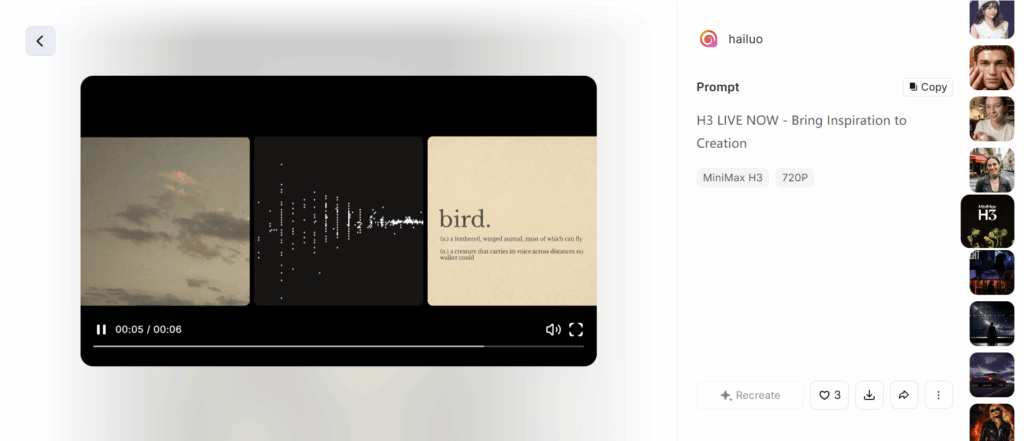
Quick Specs at a Glance
| Attribute | Hailuo 3.0 (MiniMax H3) |
| Resolution | Native 2K (2560×1440) |
| Frame Rate | 24 fps |
| Max Duration | 4–15s |
| Inputs | Text-to-video, Image-to-video |
| Aspect Ratios | 21:9 to 9:16 |
| Audio | Native stereo (dialogue, SFX, ambience), same-pass generation |
| Omni-Reference | Up to 9 images + 3 video + 3 audio clips (12 files max) |
| Instruction Editing | Yes |
| Release Date | July 31, 2026 |
Hailuo 3.0 Key Features
Native 2K Resolution and 24 fps Output
Hailuo 3.0 generates at true native 2K (2560×1440), no upscaling from a lower resolution. Every frame delivers broadcast-ready detail across lighting, skin texture, and surface materials. For creators, this matters in practice: native 2K provides more room for cropping and reframing during editing without immediately losing detail, something previous 1080p AI video models forced creators to work around.
Omni-Reference: The Most Powerful Consistency Control Yet
One of H3's most significant differentiators is Omni-Reference, a control system that accepts up to 9 reference images, 3 video clips, and 3 audio clips simultaneously (12 files max). This lets you lock in a character's appearance, visual style, motion patterns, and even voice across multiple generated shots.
This level of reference input is unusually generous compared to competing models. In practice, it makes H3 well-suited for serialized content, branded sequences, and any project that requires consistent characters across scenes.
Native Synchronized Audio in a Single Pass
H3 is the first Hailuo model to generate dialogue, sound effects, and ambient atmosphere in the same generation pass as the video, no separate audio workflow required. The audio is timed to on-screen action, which means a product hitting a surface, a character speaking, or a door closing will have matching stereo sound without post-production.
This is a meaningful shift. A silent AI video is a visual asset. A video with usable, synchronized audio is closer to an editable first cut.
Instruction-Based Editing
Instead of regenerating a clip from scratch to make changes, H3 allows instruction-based editing: describe what you want changed, swap a character, alter an object, change the scene, adjust the audio, or re-pace the shot, and the model applies it without rolling entirely new footage. On the Artificial Analysis leaderboard, H3 ranks #1 globally for video editing capability, validating this as a genuine strength rather than a marketing claim.
For revision-heavy production workflows, this reduces wasted generations significantly.
Extended Duration: Up to 15 Seconds (Plus Smart Expansion)
H3 generates clips of 5–15 seconds in a single pass. That's enough for a complete product reveal, a short narrative beat, or a social video hook. For longer sequences, an Extend tool allows clips to grow to approximately 30 seconds while preserving character identity, camera direction, and motion continuity.
Flexible Aspect Ratios
H3 supports aspect ratios from 9:16 (vertical/mobile) to 21:9 (cinematic widescreen), making it practical for social media content, advertising, and traditional video production in the same workflow.
Hailuo 3.0 vs Hailuo 2.3: What Changed
The jump from Hailuo 2.3 to H3 is generational, not incremental.
| Feature | Hailuo 2.3 | Hailuo 3.0 (H3) |
| Resolution | 1080p | Native 2K (2560×1440) |
| Max Duration | ~10s | 15s (+ extendable to ~30s) |
| Native Audio | No | Yes (stereo, same-pass) |
| Omni-Reference | No | Yes (9 images + 3 video + 3 audio) |
| Instruction Editing | No | Yes |
| Aspect Ratios | Limited | 21:9 to 9:16 |
If you've used Hailuo 2.3, H3 is a straightforward upgrade on every major dimension: resolution, duration, audio, and creative control.
Hailuo 3.0 vs Competitors: Where It Stands in 2026
The 2026 AI Video Landscape
The frontier video field in mid-2026 is crowded. On human-preference arenas, Kling 3.0 has led text-to-video rankings, ByteDance Seedance 2.0 has topped audio-inclusive rankings, and Google Veo 3.1 is noted for high-fidelity synchronized dialogue. Runway Gen-4.5, Luma Ray 3.2, and Pika 2.3 are also serious options. OpenAI discontinued Sora's web and app experiences in April 2026, so it is no longer a model to start new workflows on.
Model Comparison Table
| Feature | Hailuo 3.0 | Kling 3.0 / 4.0 | Veo 3.1 | Seedance 2.0 |
| Native Resolution | 2K | 1080p / 4K¹ | 1080p | 1080p |
| Native Audio | Yes (stereo) | Yes | Yes (48kHz) | Yes |
| Omni-Reference | Yes | Limited | Limited | Limited |
| Instruction Editing | Yes | No | No | No |
| Max Duration | 15s (+30s) | 5–10s | Varies | ~10s |
Kling 3.0 standard outputs 1080p; Kling 4.0 adds native 4K. Specs cited here reflect community reporting and may vary by platform integration. Verify on each provider's current documentation.
Where Hailuo 3.0 Wins
H3's pitch is not "highest resolution", Kling 4.0 and upcoming models push native 4K. H3's edge is on control, audio, and iteration speed: Omni-Reference with up to 12 reference files, one-pass synchronized stereo audio, and instruction-based editing that avoids full regeneration. Combined with MiniMax's characteristically fast generation and a 2K price point around ¥0.8/sec (roughly one-third of competing flagship models), H3 is particularly compelling for workflows that need consistency across shots and rapid revision cycles.
A Note on Independent Benchmarks
Because H3 is brand new, it does not yet have an established independent arena score for video generation. Public leaderboards still list its predecessor, Hailuo 2.3. Treat any "which looks best" claims as provisional, test H3 on your own prompts before committing to a production workflow. The one verified benchmark exception: H3's instruction-based video editing capability already ranks #1 globally on Artificial Analysis.
Best Use Cases for Hailuo 3.0
Short Commercials and Product Videos
A 15-second clip is a natural fit for social advertising formats. Creators can structure a complete commercial around a product reveal → key movement → benefit → final hero shot, with native audio generating atmospheric sound and music alongside the visuals. H3's Motion Brush-style localized control lets you animate the product while keeping the background static. From there, you can pull the best generations directly into Marketing Studio for editing, branding, and campaign assembly.
Social Content for Reels, Shorts, and TikTok
The 9:16 aspect ratio support and dynamic camera movement make H3 well-suited to short-form vertical content. Its combination of longer duration and cinematic motion can reduce the need to stitch multiple unrelated generations together.
Music Visuals and Performance Clips
Native audio makes H3 particularly useful for music-led content. The key test for any music visual is rhythm, whether the motion and cuts actually align with the audio rather than simply coexisting beside it. Check this in your own test generations before using H3 for final-facing music work.
Short Narrative Scenes
15 seconds is long enough for a meaningful story beat: a character discovering an object, a short exchange between two people, a quiet moment that shifts. Think of H3 as a shot or sequence generator, not a full-length video tool, and it delivers genuine narrative utility.
Pre-Visualization and Creative Testing
Even when a final project will be filmed traditionally, H3 can help directors, agencies, and marketing teams visualize camera movements, scene composition, lighting direction, and action timing before committing to production costs.
Hailuo 3.0 Limitations to Know Before You Use It
No Official Public Benchmarks
MiniMax has not published head-to-head quality data for video generation. Specs and capability claims come from integration partners, early-access materials, and community testing. Verify before building a production workflow on any specific claim.
Long-Sequence Consistency
A 15-second clip gives the model more opportunities to introduce visual errors, character drift, changing clothing details, object deformation, or inconsistent backgrounds. Longer clips are more useful, but more demanding. Test your specific use case at full duration before committing.
Dialogue Accuracy
Native audio does not automatically mean perfectly accurate speech. Pronunciation, emotional delivery, speaker identity, and lip synchronization all need practical evaluation. Don't use H3 dialogue output for final-facing client work without testing.
Pricing Varies by Platform
H3 is available through MiniMax's Hailuo platform and partner tools. There is no single unified price, cost depends on which platform you access H3 through. MiniMax's own API pricing is ¥0.8/sec at 2K, roughly one-third of comparable flagship models. Check each provider's current pricing page before starting a project.
No Open Weights (Yet)
H3 is a closed model for now, no local inference, no fine-tuning, no self-hosting. MiniMax has announced plans to release open weights "in the coming days," but as of this review's publication, they are not yet available. Teams that need on-premise video generation will need to wait for the open-weight release or look elsewhere.
Hailuo 3.0 Prompt Guide
The Core Prompt Structure
Because H3 combines longer video, dynamic motion, and native audio, prompts should be written more like compact production briefs than simple image-generation descriptions. A reliable structure is:
Subject → Scene → Action → Camera → Visual Style → Audio
Describe each element clearly, in chronological order, and keep the total number of major actions limited, too many events in one prompt gives the model conflicting priorities.
Prompt Examples by Use Case
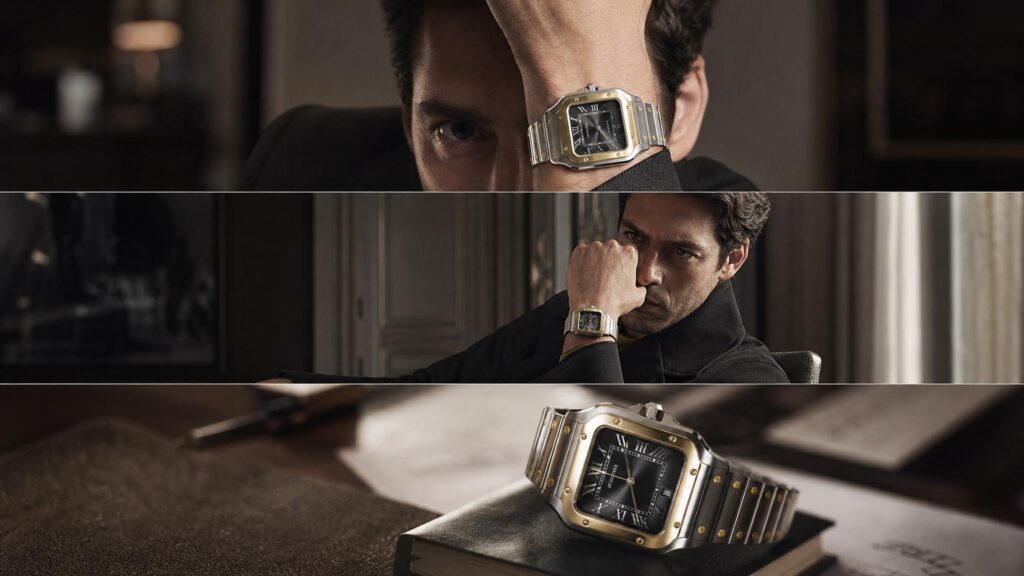
Example 1: Product Commercial
A luxury silver watch rests on a dark stone pedestal inside a modern gallery. The camera slowly pushes forward as a beam of light moves across the metal surface. Fine dust floats in the air. Premium cinematic commercial style, controlled movement, high contrast lighting, subtle mechanical ticking and deep ambient sound.
Why it works: Single subject, one camera movement, clear lighting direction, audio described at the end. The model has exactly one job per element.
Example 2: Short Narrative Scene
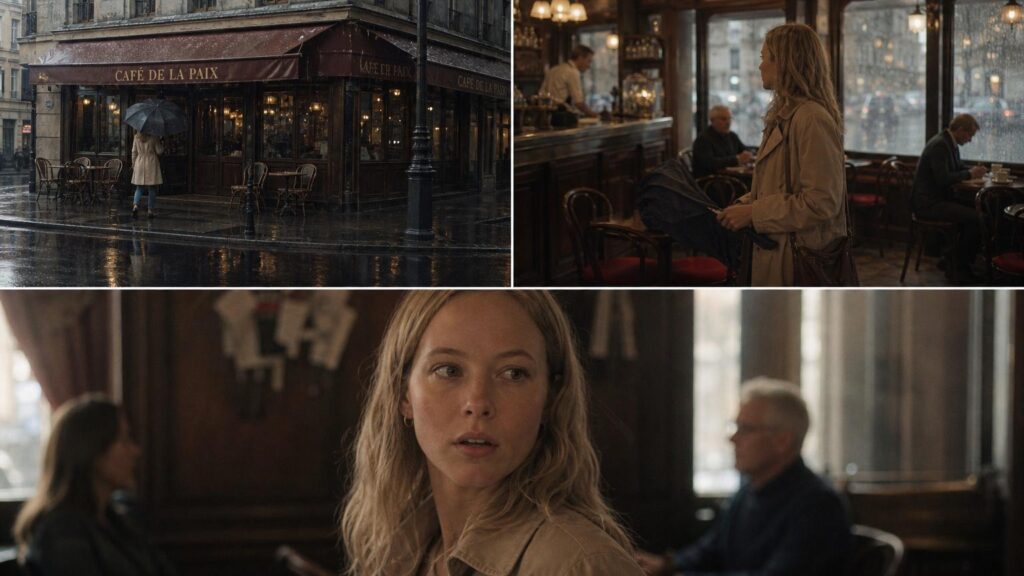
A young woman enters a quiet café during heavy rain. She closes her umbrella, looks toward the counter, and notices an old friend. Begin with a wide exterior shot, cut to a medium tracking shot as she enters, then finish on a close-up of her surprised expression. Natural dialogue ambience, rain against the windows, and soft piano music.
Why it works: Three shots described in order (wide → medium → close-up). The camera language is explicit. Audio cues match the emotional arc of the scene.
Example 3: Fashion / Lifestyle Social Content
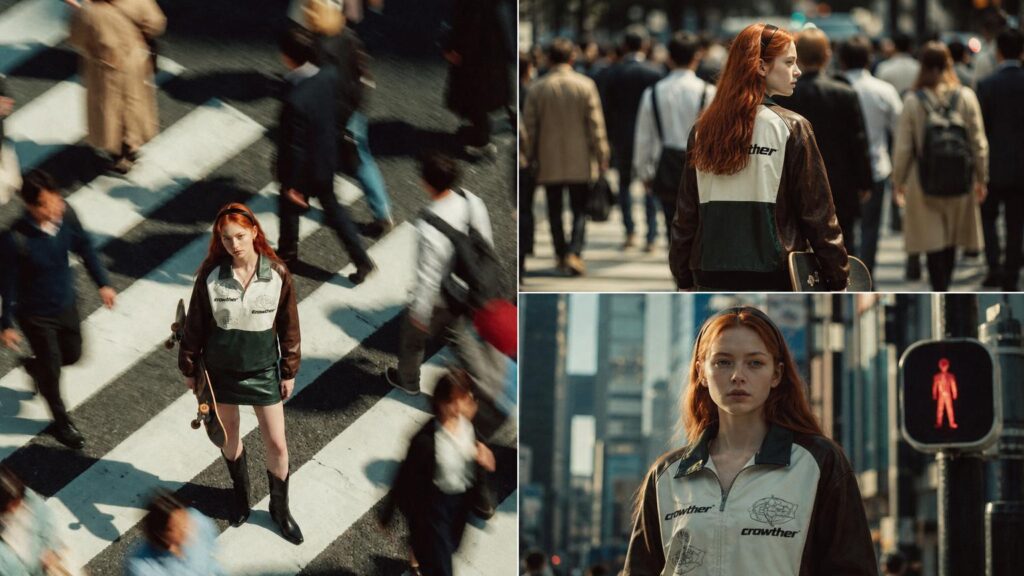
A red-haired woman stands perfectly still in a busy city crosswalk holding a skateboard, wearing a vintage color-blocked leather jacket. The camera holds a steady medium shot on her while the surrounding crowd rushes past in a fast motion blur. Cinematic urban daylight, high contrast, shallow depth of field. Bustling city ambience, rushing footsteps, distant traffic.
Why it works: Contrasting a perfectly static subject with a motion-blurred crowd creates intense visual dynamism without requiring complex subject animation. The ambient audio firmly grounds the chaotic urban atmosphere without overcomplicating it.
Example 4: Cinematic Action Beat
A lone figure in a dark coat runs across a rain-soaked rooftop at night, pursued by headlights from below. The camera follows in a low handheld chase shot, then cuts to a wide aerial view as the figure leaps between buildings. High contrast noir lighting, fast-paced editing rhythm, intense percussion and city ambient sound.
Why it works: Two-shot structure (chase → aerial) with clear contrast between them. The audio mirrors the visual energy. Keeping it to two beats lets H3 maintain subject consistency across the cut.
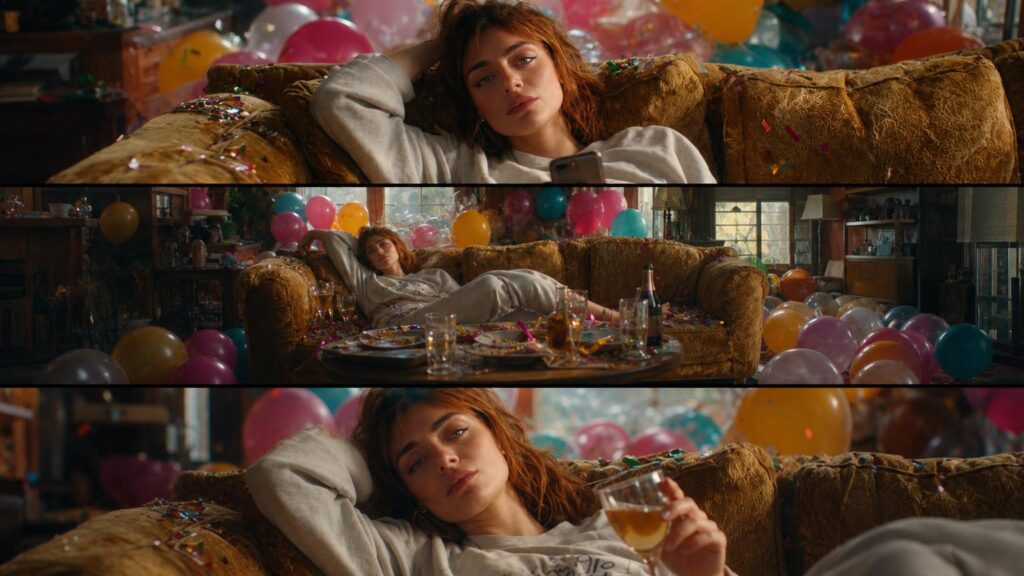
Example 5: Nature / Atmospheric Video
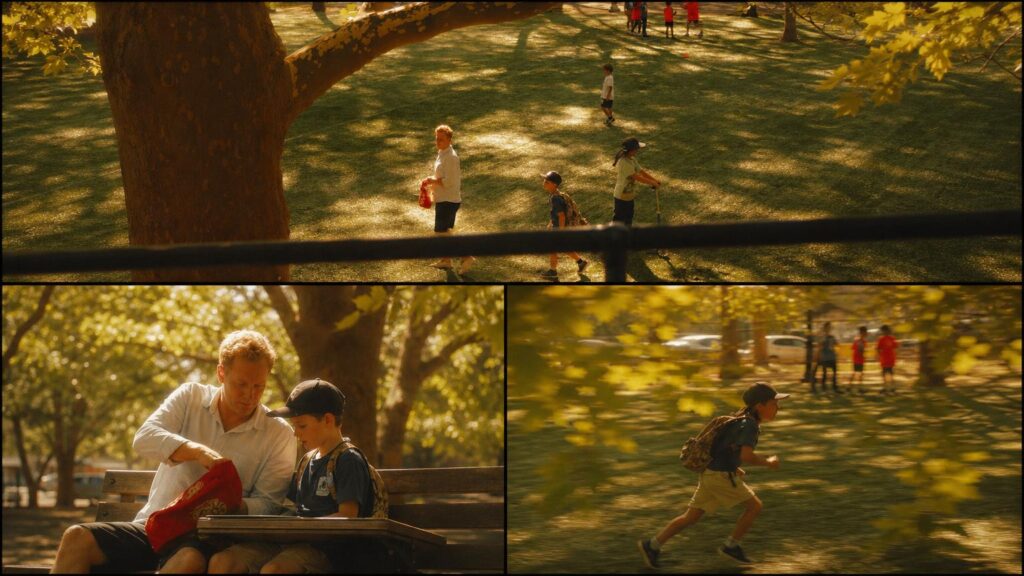
A medium shot of a father and young son sitting quietly on a wooden bench under dappled golden-hour sunlight, the father reaching into a red bag. The camera cuts to a dynamic tracking shot of the boy running energetically across the sunlit grass, framed by blurred golden leaves in the foreground. Warm cinematic lighting, long shadows, ambient park sounds of distant children, and the rustling of leaves.
Why it works: Two-shot structure (intimate static bench → dynamic tracking action) creates clear pacing contrast. The mood shifts from calm observation to energetic play. The strong, consistent golden-hour lighting and dappled tree shadows act as a visual anchor, helping the model maintain subject and environmental consistency across the cut.
Prompt Writing Tips
- Describe actions chronologically. H3 handles sequence better when the brief reads like a shot list.
- Limit major actions to 2–3. More than that and the model starts dropping or compressing events.
- Name the camera movement explicitly. "Camera slowly pushes forward" or "wide shot cutting to close-up" gives the model clear direction.
- Separate visual and audio instructions. Put lighting, style, and motion first; add audio cues at the end.
- Specify what must stay consistent. If a character or object needs to look the same throughout, name that constraint.
- Avoid filling every second. Leave room for the model to breathe between events.
- Generate multiple variations. H3 produces different results across runs, review 3–5 before selecting a final clip.
- Use Omni-Reference for characters. If you need a specific face or style to stay consistent across clips, upload reference images rather than describing them in text, the model will anchor to the visual more reliably.
Frequently Asked Questions
What is Hailuo 3.0?
Hailuo 3.0 is MiniMax's next-generation AI video model, also known as MiniMax H3. It generates native 2K video at 24fps, with clips from 5–15 seconds (extendable to ~30s), synchronized stereo audio in a single pass, and Omni-Reference control for style and character consistency.
Is Hailuo 3.0 the same as MiniMax H3?
Yes. MiniMax H3 is the technical model name; Hailuo 3.0 is the consumer-facing brand name used on MiniMax's Hailuo platform and by partner tools. They refer to the same model. (Note: MiniMax's official documentation uses only "MiniMax H3", "Hailuo 3.0" is the widely adopted community name.)
How is Hailuo 3.0 different from Hailuo 2.3?
H3 upgrades resolution from 1080p to native 2K, extends maximum clip duration from ~10 seconds to 15 seconds (plus ~30s via Smart Expansion), adds native synchronized stereo audio for the first time, and introduces Omni-Reference and instruction-based editing, none of which existed in Hailuo 2.3.
Is Hailuo 3.0 free to use?
Hailuo 3.0 is available through MiniMax's Hailuo 3.0 platform and various partner tools, each with their own pricing tiers. Free trials may be available on some platforms. MiniMax's own API pricing is ¥0.8/sec at 2K (roughly $0.13/sec), approximately one-third the cost of competing flagship models. Check each provider's current pricing as of mid-2026.
What is Omni-Reference in Hailuo 3.0?
Omni-Reference is H3's consistency control system. It accepts up to 9 reference images, 3 video clips, and 3 audio clips simultaneously (12 files max) to keep a character's appearance, visual style, motion, and voice consistent across multiple generated shots.
How does Hailuo 3.0 compare to Kling 3.0?
Kling 3.0 (standard) outputs 1080p, while Kling 4.0 offers native 4K. Hailuo 3.0 sits in between at native 2K. H3 counters with Omni-Reference (more generous reference inputs), one-pass synchronized stereo audio, and instruction-based editing, all at roughly one-third the per-second cost of competing flagship models. The right choice depends on your workflow: Kling 4.0 for maximum resolution, H3 for control, consistency, and affordability.
Conclusion
Hailuo 3.0 (MiniMax H3) is a meaningful upgrade for AI video production in 2026. Native 2K output, synchronized stereo audio in a single pass, 15-second clips with Smart Expansion, and Omni-Reference's unusually generous consistency control make it a strong option for social advertising, music visuals, short narrative content, and creative pre-visualization.
It won't out-resolve rivals pushing native 4K, and its independent video generation benchmarks are still to be established. But on control depth, audio integration, editing capability (already ranked #1 globally on Artificial Analysis), and price-to-performance ratio, H3 is one of the most compelling video models to enter the 2026 frontier, and worth testing against your own production use cases before committing to a competing workflow.