

Video adoption in marketing has stopped being a growth story and become a baseline expectation: 91% of businesses now use video as a marketing tool, and 85% of people say watching a video has convinced them to buy a product or service, according to Wyzowl's 2026 State of Video Marketing report, the longest-running study of its kind. For ecommerce specifically, the case is even more direct: shoppers can't touch, hold, or try on a product before buying it, and video is the closest substitute for that missing sense of "real life" confirmation.
This guide walks through real ecommerce video examples from small and mid-size DTC brands, with the actual results they published, then shows exactly how any store can produce similar videos with AI, without booking a studio.
Why Ecommerce Video Matters
- 91% of businesses use video as a marketing tool, and 93% consider it an important part of their strategy.
- 85% of people say watching a video has convinced them to buy a product or service at some point.
- 96% of people have watched an explainer video to learn more about a product or service before buying it.
- On the trust side, 89% of consumers say video quality directly impacts how much they trust a brand.
Beyond these broad marketing figures, the real proof is in what happens on individual product pages, which is where the examples below come in.
Data Source: Wyzowl
Ecommerce Video Examples From Real DTC Brands
Rather than the usual roundup of Apple and Nike ads that most stores can't realistically replicate, here are real examples from small and mid-size direct-to-consumer brands, with the actual published results.
Product Demo Videos: True Classic
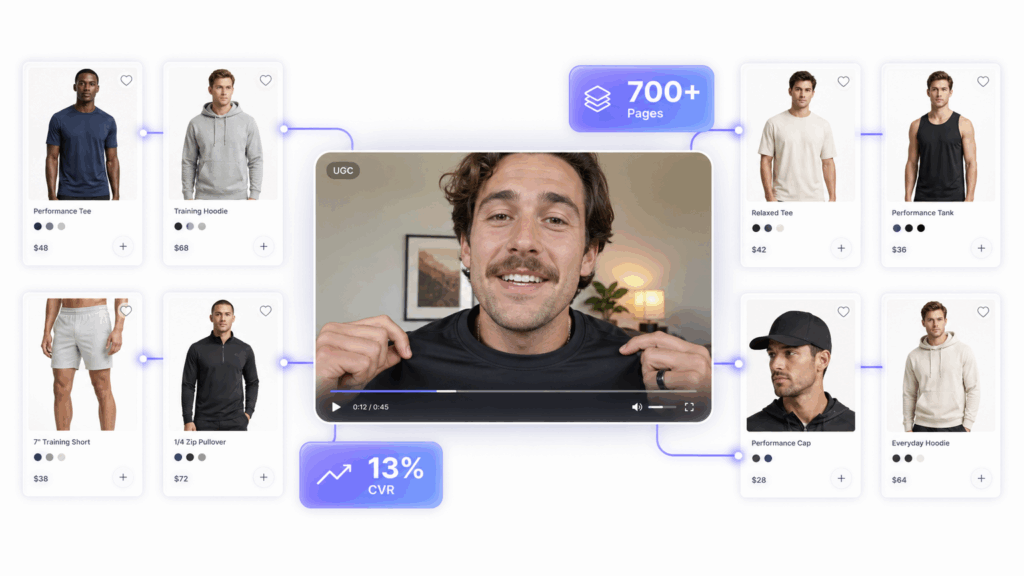
True Classic, a men's apparel DTC brand, embedded a tailored video on more than 700 individual product pages rather than relying on a handful of generic brand videos. Shoppers watched an average of 70% of each video, and the brand's video-attributed conversion rate reached 13%. The lesson: a demo video specific to each product outperforms one generic hero video reused everywhere.
Tutorial-Style Videos: Apolla
Apolla, a dancewear and grip-sock brand, matched YouTube-style tutorial and demo videos directly to relevant products, with a purchase option embedded below each video. This approach produced a 9.94% video conversion rate and a 90.54x return on investment. Tutorial content works especially well for products that need a little explanation before a shopper trusts them enough to buy.
Testimonial and UGC Videos: Ava Estell
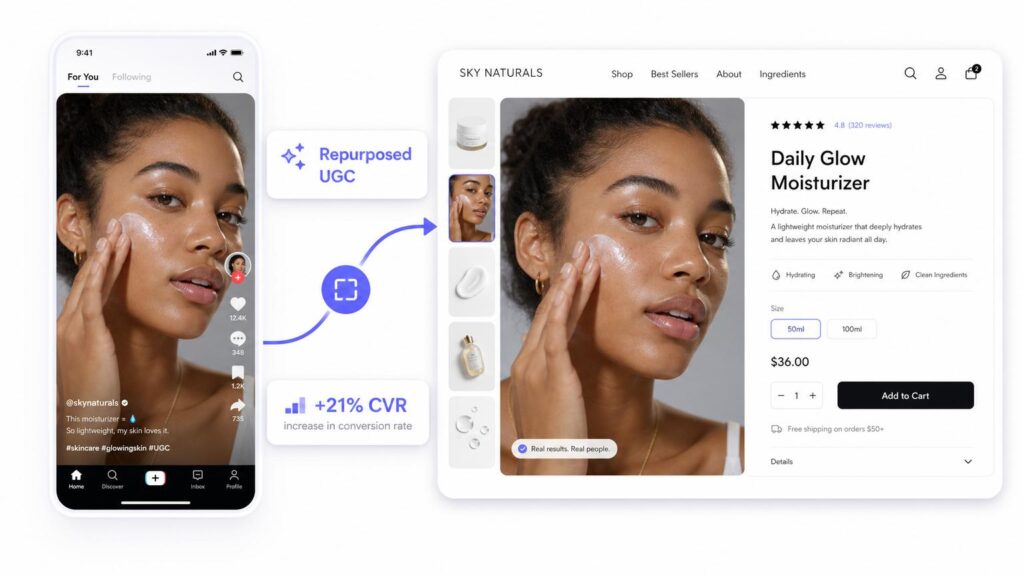
Ava Estell, a skincare brand focused on people with darker skin tones, repurposed existing Instagram Reels, TikTok clips, and customer testimonial videos directly onto its product and category pages. That approach lifted conversion rate to 21% and generated more than £743,000 in tracked revenue. This is a strong example of a brand not producing new content from scratch, but re-using UGC it already had sitting on social media.
Before-and-After Videos: Eczema Honey
Eczema Honey, an organic skincare brand, built a homepage and product-page video carousel showing real customer before-and-after results alongside short testimonial clips. Before-and-after content is genuinely persuasive for visibly transformative products, but if you plan to run this format as a paid ad rather than organic on-site content, check the platform's policy first. TikTok's advertising guidelines specifically restrict product-effect comparisons, including before-and-after results, that could create a false or exaggerated impression of outcomes (TikTok Ads Policy).
Interactive / Quiz Videos: Fresh Patch
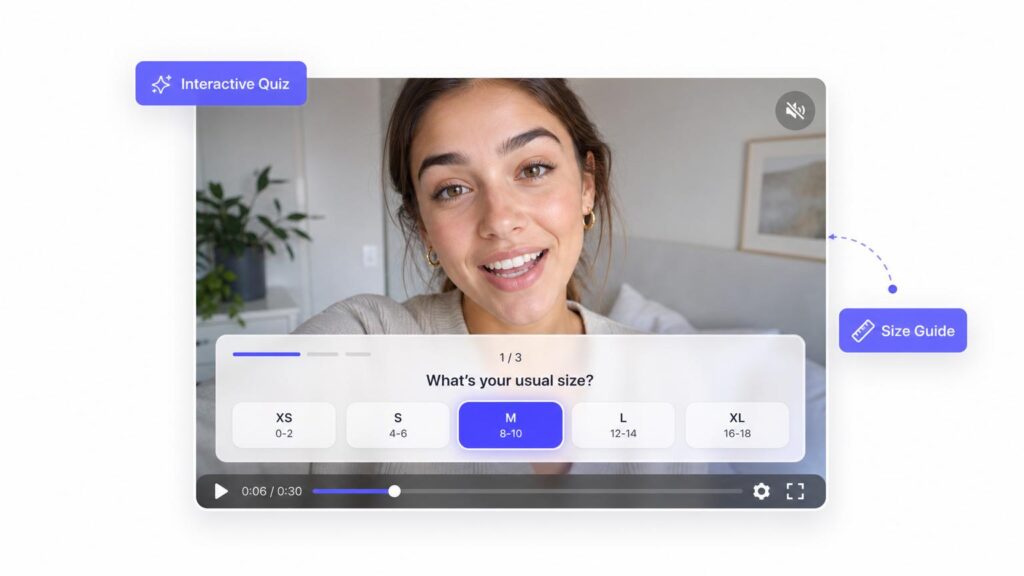
Fresh Patch, a DTC brand selling real grass patches for dogs, combined UGC videos on product pages with an interactive, founder-led video quiz that helps shoppers pick the right product size. Across more than 2.18 million widget views, the brand generated $300,000 in video-driven revenue, a 20.79x ROI, a 7.55% video conversion rate, and an 86.84% video completion rate. This is a good template for products where sizing or fit is a common source of pre-purchase hesitation.
In-Context / Lifestyle Videos: Walkee Paws
Walkee Paws, a smaller DTC pet brand, used lifestyle-style product videos showing the product in real, everyday use, generating over $97,000 in revenue at an 8% average conversion rate. In-context video tends to feel the least "ad-like" of any format, which is often exactly why it converts.
The Catch: Why Most Stores Never Get Around to This
If traditional video production were easy, every store would already be doing it at this scale. In practice, brands trying to build an in-house video program run into a consistent set of obstacles: choosing the right camera and lighting for video (which is different from photography lighting), coordinating timelines across pre-production, filming, and revisions, managing stakeholder approvals, and keeping color and product accuracy consistent across every clip (Pixelz). None of that is a reason to skip video, it's the reason most small and mid-size stores end up with far fewer product videos than they actually need.
This is exactly the gap Marketing Studio is built to close.
How to Create Ecommerce Videos with AI
The generic version of this workflow, "type a prompt, get a video", isn't very useful if you're actually running a store with a real catalog, multiple markets, and specific platform requirements to hit. Here's what the process looks like when you account for those constraints.
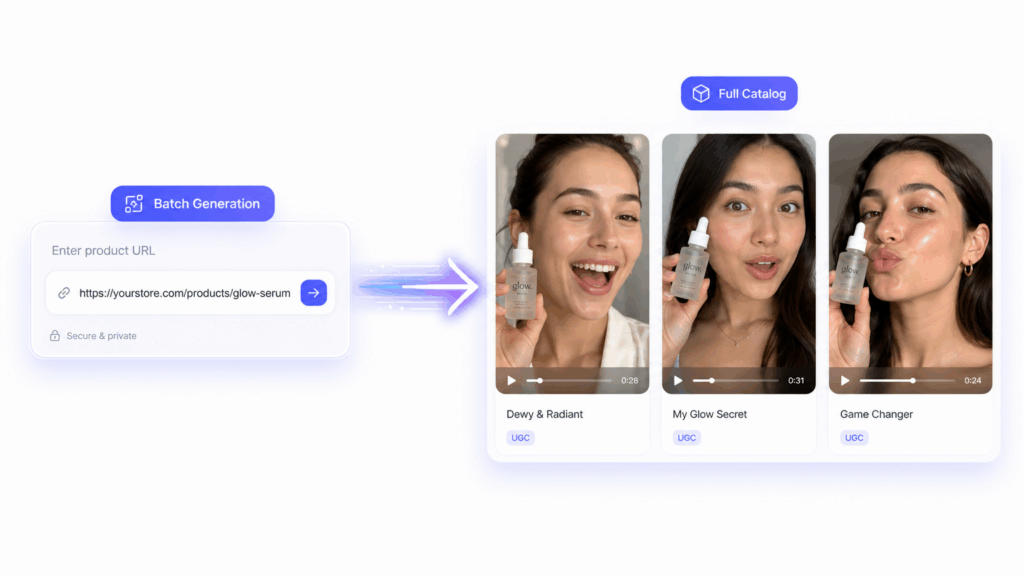
Step 1: Feed It Your Actual Catalog, Not Just One Product
Paste a single product link to URL to video or use Marketing Studio and it pulls in images, title, and key details automatically, that part is straightforward. The part that actually matters for ecommerce sellers is what happens next: instead of manually briefing one video at a time, batch-generate videos across an entire product category (all 40 SKUs in a collection, for example) from the same base script structure, swapping in each product's specific images and details automatically. This is the difference between having video for your 3 bestsellers and having video across your whole catalog, which matters directly, since both True Classic's and Apolla's results above came specifically from having a video on every product page, not just a handful.
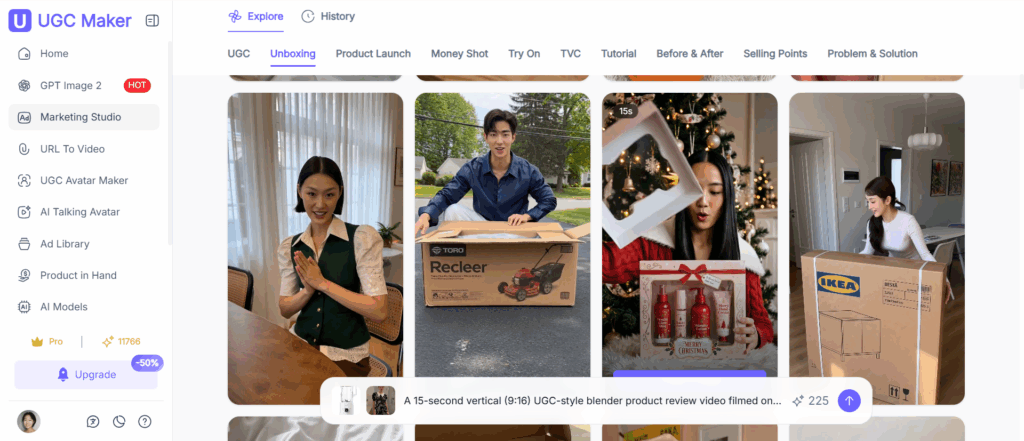
Step 2: Write the Script to Match Your Product Category, Not a Generic Template
A script that works for a t-shirt doesn't work for a skincare serum or a kitchen gadget, and treating them the same is the most common reason AI-generated product videos feel generic. Adjust the script emphasis by category:
- Apparel and accessories: Pull sizing, fit, and material details directly from the listing so the script can address fit hesitation (Fresh Patch's sizing-quiz result above shows how much this specific hesitation matters for conversion). Show the product on-body or in scale, not just as a flat lay.
- Skincare and beauty: Keep result claims general and avoid "cures," "eliminates," or guaranteed-outcome language. If you're tempted to use a before-and-after structure, remember this is the exact format TikTok's ad policy scrutinizes for exaggerated impressions, keep it for organic content or ensure the claim is substantiated before running it as an ad.
- Electronics and gadgets: Lead with the single spec or function that differentiates the product, since these categories tend to lose viewers when the script tries to cover every feature at once. A tutorial-style structure (like Apolla's approach above) tends to outperform a pure demo here.
- Supplements and consumables: Avoid specific health outcome claims entirely, regulatory risk here is real regardless of platform, and no AI tool can safely generate FDA- or FTC-compliant health claims on your behalf. Keep the script to ingredients, format, and usage, not results.
- Home and lifestyle goods: In-context, everyday-use footage (Walkee Paws's approach above) tends to outperform a studio-style product-only shot, since the buying decision is often "does this fit my space/routine," not just "does this work."
Step 3: Localize for Every Market You Actually Sell In
If you sell cross-border, generate the same script in every target language rather than writing separate briefs per market, the script structure stays the same, but currency, sizing conventions, and idiomatic phrasing need to be adapted per locale, not just translated word-for-word. This is also the point to double-check that your landing page and video are in matching languages: several ad platforms, including TikTok, specifically require the landing page language to match the ad's target market as part of their approval process.
Step 4: Match Your Export to Where the Video Will Actually Live
Different placements have different technical requirements, and getting this wrong is one of the most common reasons a video underperforms or gets rejected outright:
| Placement | Aspect Ratio | Length | Notes |
| Amazon product detail page | 16:9 | 6–45 seconds (30s or under performs best) | No direct competitor comparisons or unsubstantiated claims allowed (Amazon guidance) |
| Amazon A+ Content | 16:9 | Up to 2 minutes | Requires Brand Registry enrollment |
| TikTok Shop / organic TikTok | 9:16, 1080×1920 | 15–60 seconds for product content | Significantly AI-generated content needs an AIGC label or equivalent disclosure (TikTok Ads Policy) |
| Shopify / your own PDP | Flexible, 16:9 or 1:1 commonly used | Under 60 seconds recommended | Autoplay is usually muted by default, captions carry the message |
| Meta Reels / Stories ads | 9:16 | Short-form performs best | AI-generated or significantly AI-edited ads get an "AI info" label (Meta) |
Rather than uploading one master file everywhere, export the platform-specific cut for each placement you're actually using, the safe zones, captions position, and pacing all need to shift slightly between a vertical TikTok cut and a widescreen Amazon PDP video.
Step 5: Review Before Publishing, Not After
Before anything goes live, check three things specifically: that the product is visible within the first couple of seconds, that any claim in the script is one you can actually stand behind for that specific platform's ad policy, and that the correct AI-disclosure label or on-screen disclosure is applied if the platform requires one for that placement.
Ecommerce Video Best Practices
- Get to the product fast. Across the examples above, the highest-converting videos show the actual product within the first few seconds rather than opening on a long lifestyle intro.
- Match video length to intent. Wyzowl's 2026 data found that most marketers (71%) consider 30 seconds to 2 minutes the most effective length range for marketing video, a useful benchmark for product pages and paid social alike.
- Use captions. A large share of social video is watched without sound, so the message needs to work with captions on and audio off.
- Test more than one video per product. True Classic's and Apolla's results above both came from treating video as a per-product asset, not a single reused clip.
- Reuse what you already have. Ava Estell's result shows that repurposing existing UGC can outperform producing something new from scratch.
Data Source: Wyzowl
FAQ
What is an ecommerce video?
An ecommerce video is any video created to showcase, explain, or sell a product on an online store, including product demos, tutorials, testimonials, unboxing clips, and lifestyle content used on product pages, ads, or social channels.
Do I need a professional studio to make ecommerce videos?
No. While studio production still has a place for hero brand films, the examples above show that consistent, product-specific video, even simple demo or testimonial content, drives measurable results without a full studio setup, and AI tools now make that possible without hiring a crew.
Can AI-generated ecommerce videos convert as well as filmed ones?
The brands above achieved strong results using a mix of UGC, filmed content, and interactive video, which shows that authenticity and product clarity matter more than production budget. AI-generated video is designed to replicate that same authentic, product-first format at a fraction of the time and cost.
How long should an ecommerce product video be?
Most marketers (71%) rate 30 seconds to 2 minutes as the most effective range, according to Wyzowl's 2026 research (Wyzowl), though shorter, platform-native cuts are often better for paid social specifically.